

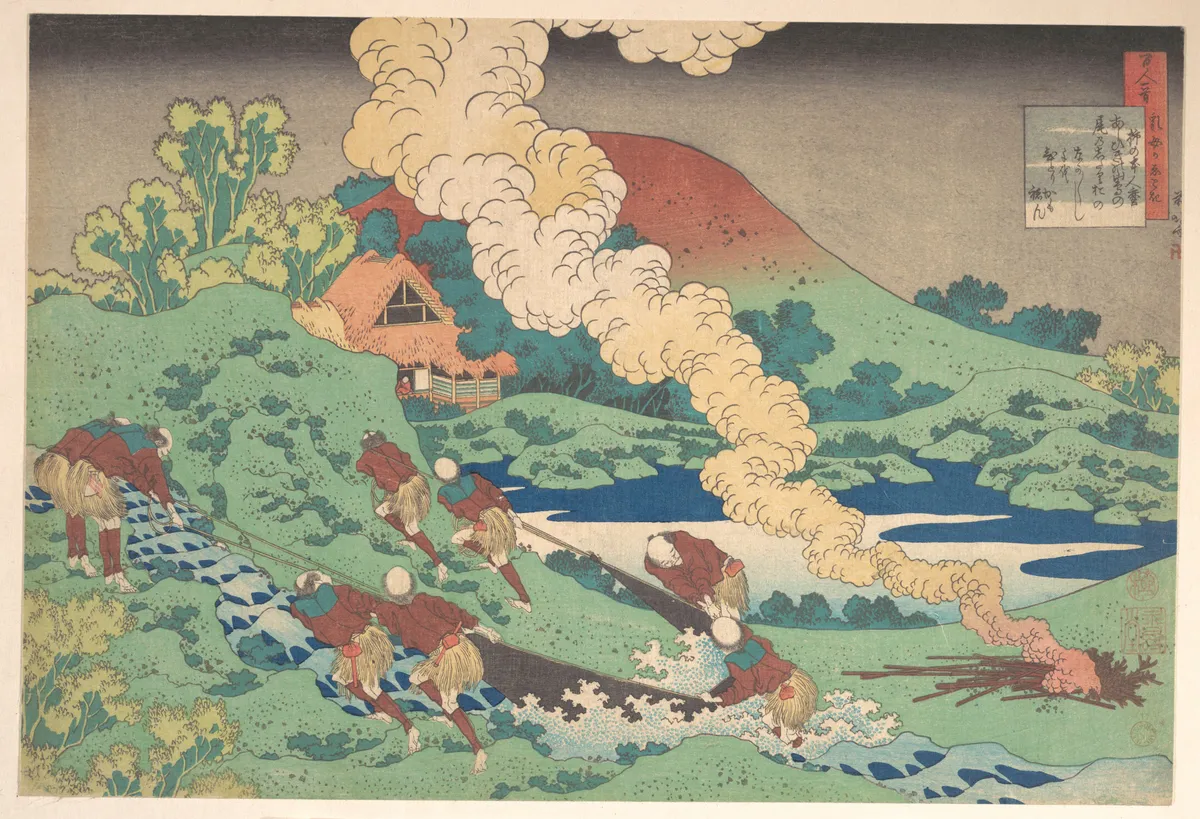
The Poet's Reverie
The air hangs heavy with the damp scent of rain-soaked earth, as a lone figure walks along a meandering path bordered by towering pines. Each footfall is softened by a carpet of pine needles, whispering secrets to the earth. Above, the sky is a tapestry of grey and silver, the clouds weaving a melancholic pattern that mirrors the thoughts of the solitary traveller.
Kakinomoto Hitomaro, a poet of great renown, pauses to gaze across the mist-laden landscape. His eyes, deep pools of contemplation, trace the gentle curve of the distant hills as they dissolve into the horizon. The world seems to exhale, a long, slow breath that carries with it the rustle of leaves and the distant call of a cuckoo, hidden somewhere within the shrouded canopy.
In the hushed silence, Hitomaro feels the weight of his words, each syllable a pebble cast into the vast ocean of time. The poem he carries within him is a delicate balance of longing and resignation, an echo of the natural world that surrounds him. As he stands, a breeze stirs, lifting the hem of his robes, and with it, the fragrance of the forest—fresh, earthy, eternal.
Hokusai captures this moment, the essence of a man entwined with the land, the poem an invisible thread binding them. The print is a symphony of subtle hues and textures, where nature and poetry coalesce into a singular vision of serene beauty.
Historical Echo
In 1839, Katsushika Hokusai, an artist whose brush danced between the realms of the earthly and the divine, turned his gaze to the poetic words of Kakinomoto Hitomaro. Part of the series "One Hundred Poems Explained by the Nurse," this woodblock print embodies the quiet reverence of the poet's solitary journey, echoing the timeless connection between humanity and nature. The art is both an interpretation and a meditation, where Hokusai's mastery with ink and form brings to life the poet's introspection and the eternal whisper of the natural world.