

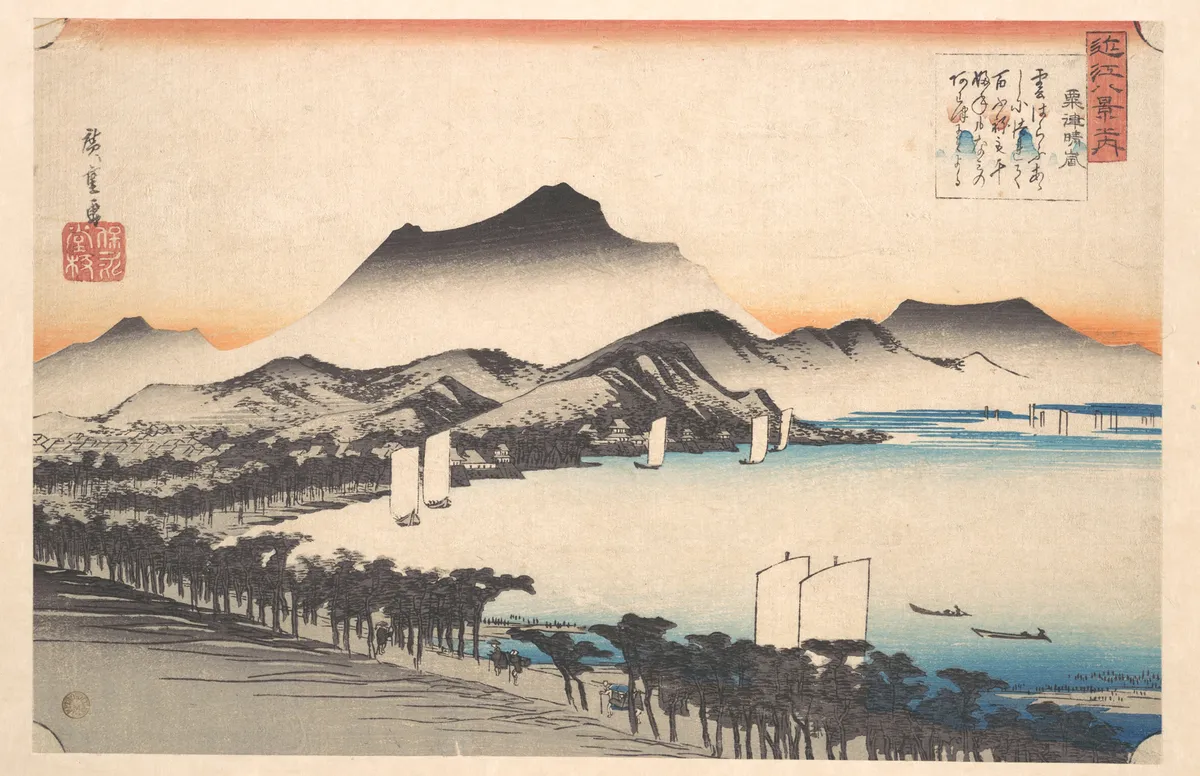
Clearing Weather at Awazu
A hush lingers over Lake Biwa, as if the earth holds its breath between the retreating whispers of rain and the first cautious sighs of sunlight. The air, still damp and cool, carries the faint aroma of wet pine and earth, mingling with the distant echo of a lone bird's call. Gentle ripples disturb the surface of the lake, their patterns fleeting and mesmerising, like a memory of the storm that has just passed.
In this delicate moment of transition, the small boats appear almost spectral upon the water, their wooden bodies creaking softly against the gentle push of the current. Fishermen, shrouded in the heavy yet protective embrace of their straw raincoats, move with a quiet grace, tending to nets that glisten with droplets—jewels of the lake caught in the morning light.
Beyond, the mountains rise in solemn majesty, their outlines softened by the lingering mist. The newly revealed sky above is an expanse of soft blues and gentle whites, an artist’s canvas still wet with the promise of a new day. The air is filled with a serene anticipation, as if the landscape itself pauses to honour the subtle beauty of nature's cycles.
Historical Echo
Hiroshige's depiction of Awazu at Lake Biwa captures not just a scene, but an ephemeral moment when the natural world holds sway over human endeavours. The ukiyo-e master, known for his ability to harmonise human presence with nature's grandeur, offers a glimpse into the tranquil beauty of Edo-period Japan, where the passage of time is measured by the rhythm of seasons and weather. The print invites the viewer to step quietly into this world, to feel the lingering touch of rain and the emerging warmth of the sun, and to listen to the silence that follows a storm.