

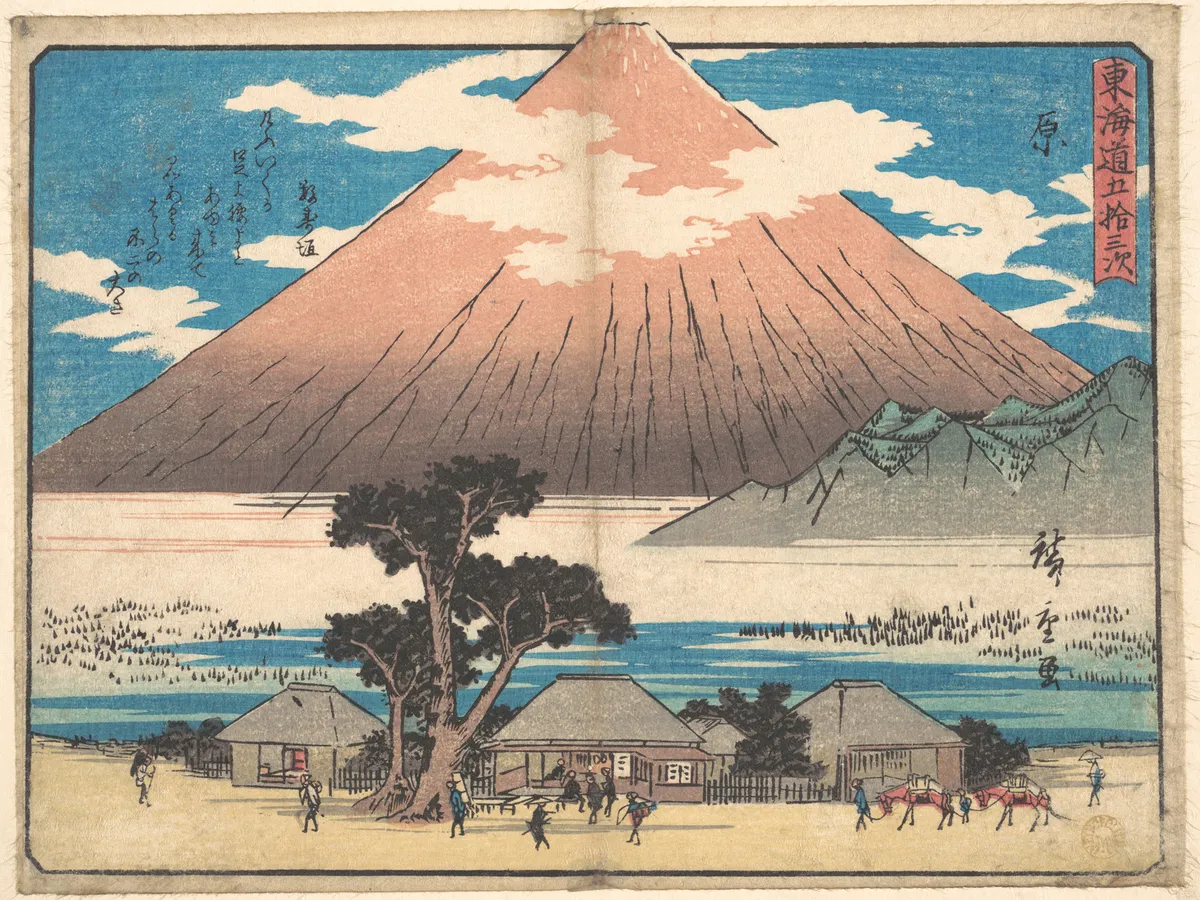
The Passage through Hara
The snow had settled on Mount Fuji like whispered secrets, its grand peak piercing the sky with a tranquil authority. Utagawa Hiroshige captured this moment, where fleeting travellers became part of the eternal landscape. The air was crisp, carrying the scent of pine and the promise of a long journey. Footsteps crunched softly on the frost-laden path, each step a gentle intrusion into the profound silence of the landscape.
A small group of travellers moved cautiously, their figures dwarfed by the towering majesty of Fuji. Their breath formed ephemeral clouds, vanishing into the cold morning light. Cloaked in winter garments, they appeared as if they had emerged from the mist itself, spectral yet grounded by their tangible weight and purpose.
The sun was a soft, diffused light, casting long shadows that danced across the undulating terrain. As they walked, the faint sound of a distant stream murmured a lullaby to the quietude, its presence felt more than heard amidst the vastness of the scenery.
Hiroshige's world was one of serene contemplation, where the ordinary became sublime. The mountains stood as timeless sentinels, witnessing the ephemeral passage of human and nature alike. Here, in Hara, time seemed to stretch, moments lingered, and the landscape breathed with a life of its own. The print spoke in hushed tones, inviting the viewer into its tranquil embrace, whispering tales of seasons past and journeys yet to come.
Historical Echo
Hara, one of the fifty-three stations of the Tōkaidō, was a place of both beauty and transition. Hiroshige, a master of capturing such transitions, depicted the travellers not just as figures in a landscape, but as participants in a timeless narrative. The Tōkaidō road was a vital artery, connecting Edo with Kyoto, and each station bore witness to countless stories, etched into the very air.
In the early 19th century, the road was bustling with samurai, merchants, and pilgrims, each step echoing the rhythm of life in Edo period Japan. Hiroshige's prints, part of his renowned series "The Fifty-three Stations of the Tōkaidō," offer a window into this world, where nature and humanity moved in a delicate dance, captured forever in the artist's sensitive gaze.