

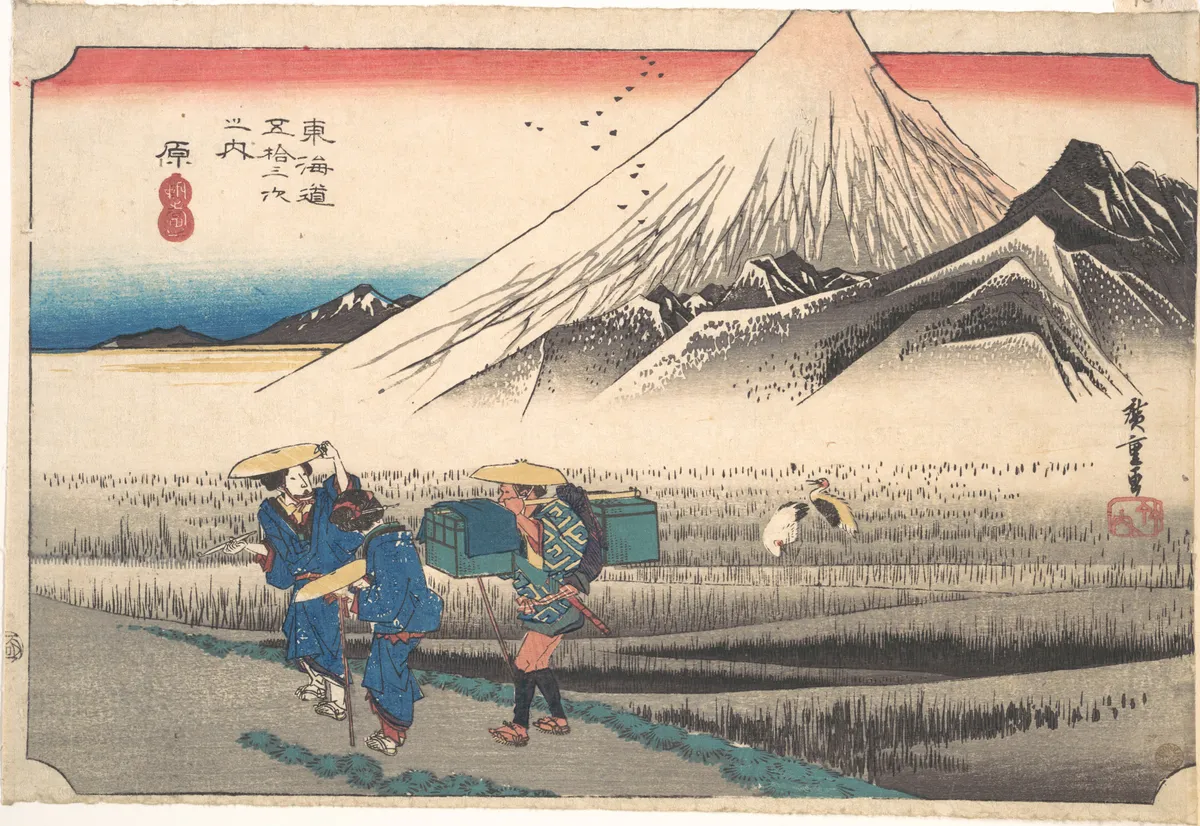
Morning at Hara
The air is crisp, holding the chill of dawn. Mount Fuji looms in the distance, majestic and eternal. Its peak catches the first light, a soft blush against the pale sky. Shadows still cling to its base, reluctant to disappear.
Travellers pass along the Tōkaidō Road. Their footsteps crunch softly on the gravel, a steady rhythm beneath the morning stillness. A lone packhorse plods forward, its breath visible in the cold air. The travellers' garments are layered against the chill, their movements measured and purposeful.
In the fields, a lone farmer pauses. He leans on his hoe, eyes drawn to the mountain. His breath mingles with the mist rising from the earth. The promise of a clear day lingers in the air, tangible and fresh.
Silence stretches, punctuated only by the distant calls of birds awakening. The road stretches onward, a ribbon of life weaving through the landscape. Fuji watches over all, silent and serene.
Historical Echo
Mount Fuji, a sacred symbol, stands timeless in Hiroshige's print. The Tōkaidō Road, a vital artery of Edo Japan, bustles even at dawn. Hiroshige captures a moment where nature and humanity coexist in quiet harmony. The travellers, the farmer, the mountain—each part of a delicate balance, preserved in woodblock and ink.