

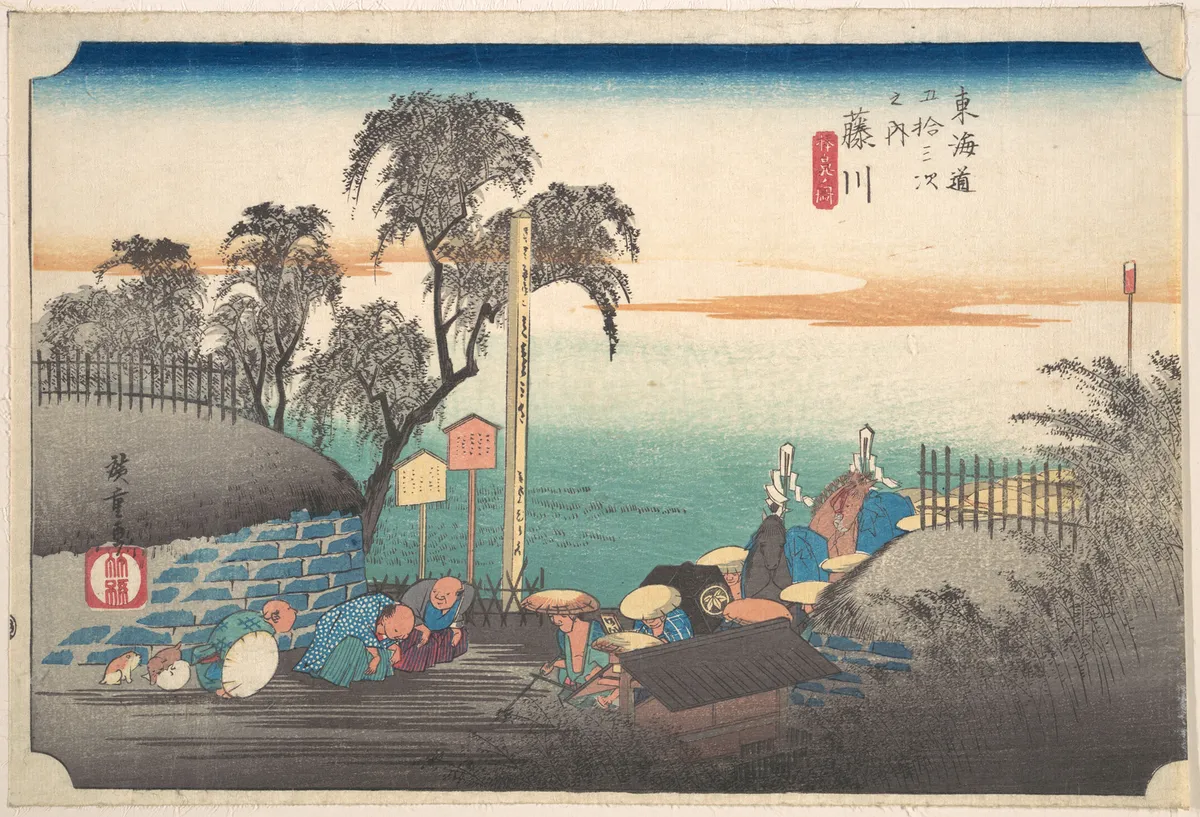
Silence over Fujikawa
A chill mist clings to the banks of the Fujikawa. Trees line the river, their branches heavy with dew. The morning is quiet. Only the soft rustle of leaves breaks the silence. A boat glides silently through the water, its passage smooth and without wake.
Two figures, cloaked in travel-worn garments, stand at its helm. Their faces are obscured by the early light. They gaze ahead, not speaking, each lost in thoughts as dense as the fog around them. The river is wide, its surface like a polished mirror, reflecting the looming mountains beyond.
The boatman, a stoic silhouette, poles the vessel with slow, deliberate motions. His straw hat casts deep shadows over his face. The air is thick with anticipation, a gentle tension that mirrors the current beneath them.
In the distance, faint outlines of other travellers appear, mere shadows against the pale sky. Each step they take is muted by the earth's dampness, their presence like ghosts in the dawn. The air tastes of earth and river, a tangible reminder of the world they traverse.
The sun begins to edge over the horizon, a pale sliver of gold. It promises warmth, yet the chill clings stubbornly to the skin. The travellers remain silent, their journey marked not by words, but by the rhythmic pulse of the river and the whisper of the wind.
Historical Echo
In the Edo period, Fujikawa was a vital stop along the Tōkaidō, the road connecting Edo to Kyoto. Travellers, merchants, and samurai alike would cross its waters. The landscape, captured by Hiroshige, is both real and ethereal. It reflects the stillness of a journey both physical and introspective. As the boat drifts onward, it carries not just people, but the weight of their stories, etched into the morning air.