

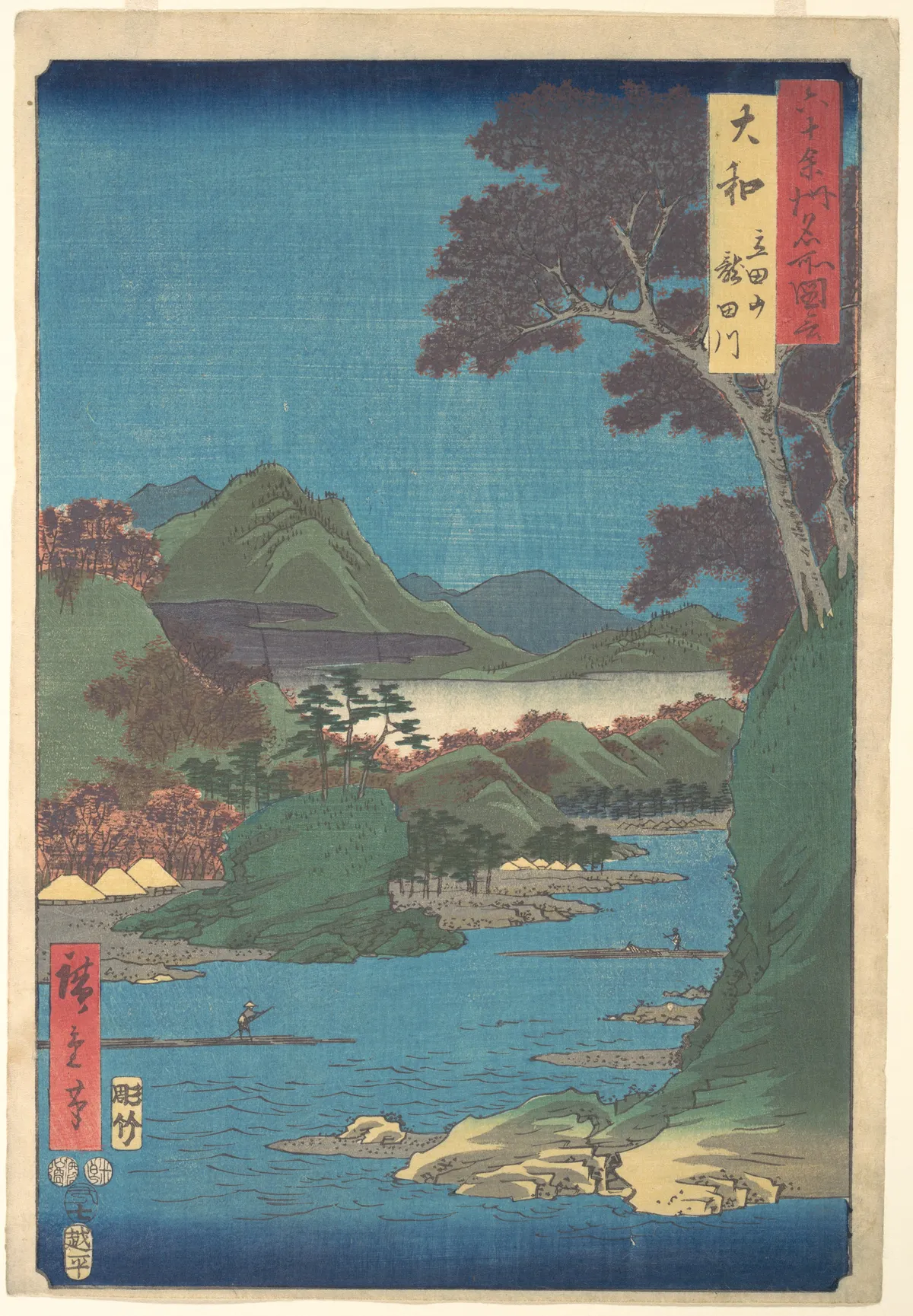
Twilight over Tatsutayama
The river glides silently, a mirror to the sky's faint glow. Shadows of the dense pines stretch long, reaching towards the water's edge. A solitary figure stands, still as stone, watching the flow. His robe whispers against the evening breeze, a soft rustle breaking the quiet.
Beyond, the silhouette of Tatsutayama rises, its contours softened by the dusk. The mountain breathes a cool mist, enveloping the trees in a gentle embrace. The air smells of damp earth and pine needles, mingling with the river's crisp scent.
A distant call of a bird echoes, a lonely note in the vastness. The man's gaze remains fixed, as if tracing the river's journey to the unseen sea. His thoughts drift like the current, unanchored, free.
The world holds its breath here, where time seems to pause. The weight of the day dissolves into the gentle murmur of the water. As night creeps in, the scene fades into a dream, leaving only whispers of its existence.
Historical Echo
In the summer of 1853, Utagawa Hiroshige captured a fleeting moment on the banks of Tatsutagawa. His print, 'Yamato, Tatsutayama, Tatsutagawa', reflects the Edo period's deep reverence for nature. It tells of a world where landscapes speak and silence holds stories untold. Hiroshige's work remains a window to a time where nature and humanity intertwined in serene harmony.