

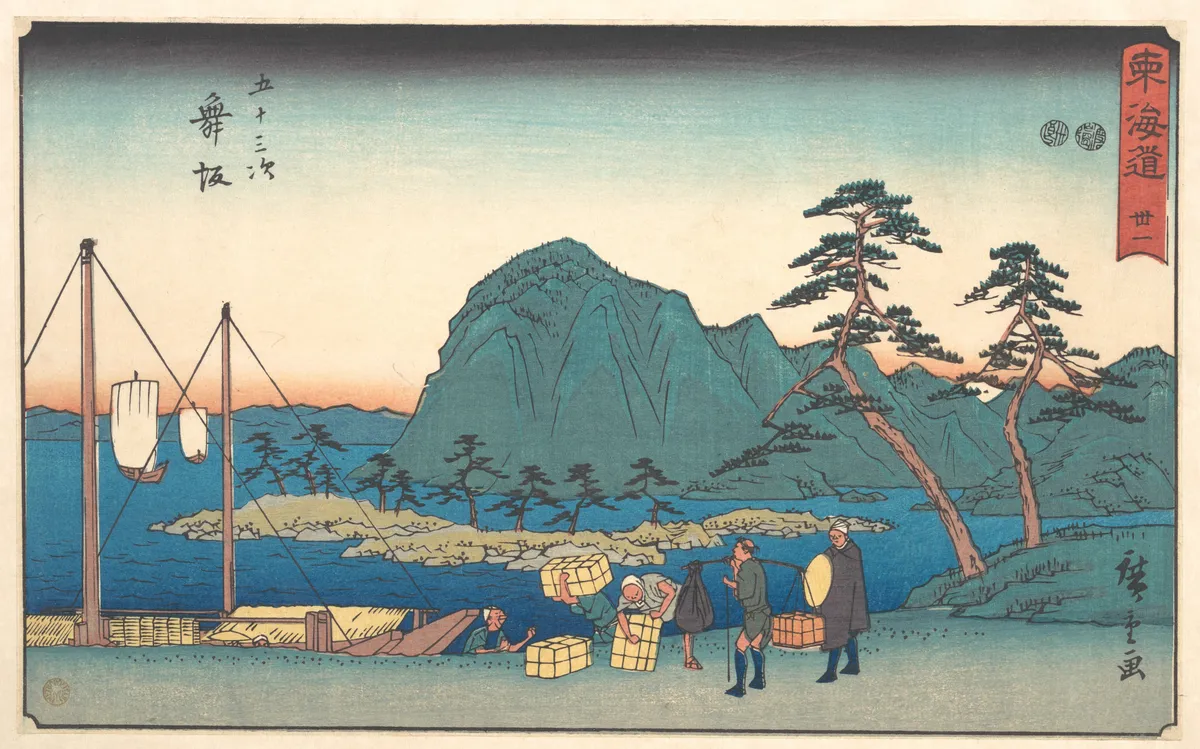
Maizaka
The air was heavy with the scent of pine. A lone traveller moved slowly along the road. His straw hat shielded him from the drizzle. The pathway curved gently, bordered by distant hills wrapped in mist. The earth beneath his sandals was damp, leaving faint imprints as he walked. Alongside him, the sea whispered in quiet intervals, its presence both comforting and vast. A solitary pine tree, its branches reaching for the sky, stood sentinel by the road. The traveller paused, the weight of his journey momentarily forgotten. He gazed at the horizon, where the land met the sea in a quiet embrace. A soft breeze rustled through the leaves, carrying with it the subtle promise of arrival.
Historical Echo
In the early 1840s, Utagawa Hiroshige captured the essence of the Tōkaidō road—a vital artery of Edo-period Japan. Maizaka, a post station along this route, was more than a mere waypoint; it was a threshold between journeys. Through Hiroshige's eyes, the landscape became a narrative of silence and solitude, a reflection of the traveler's transient existence.