

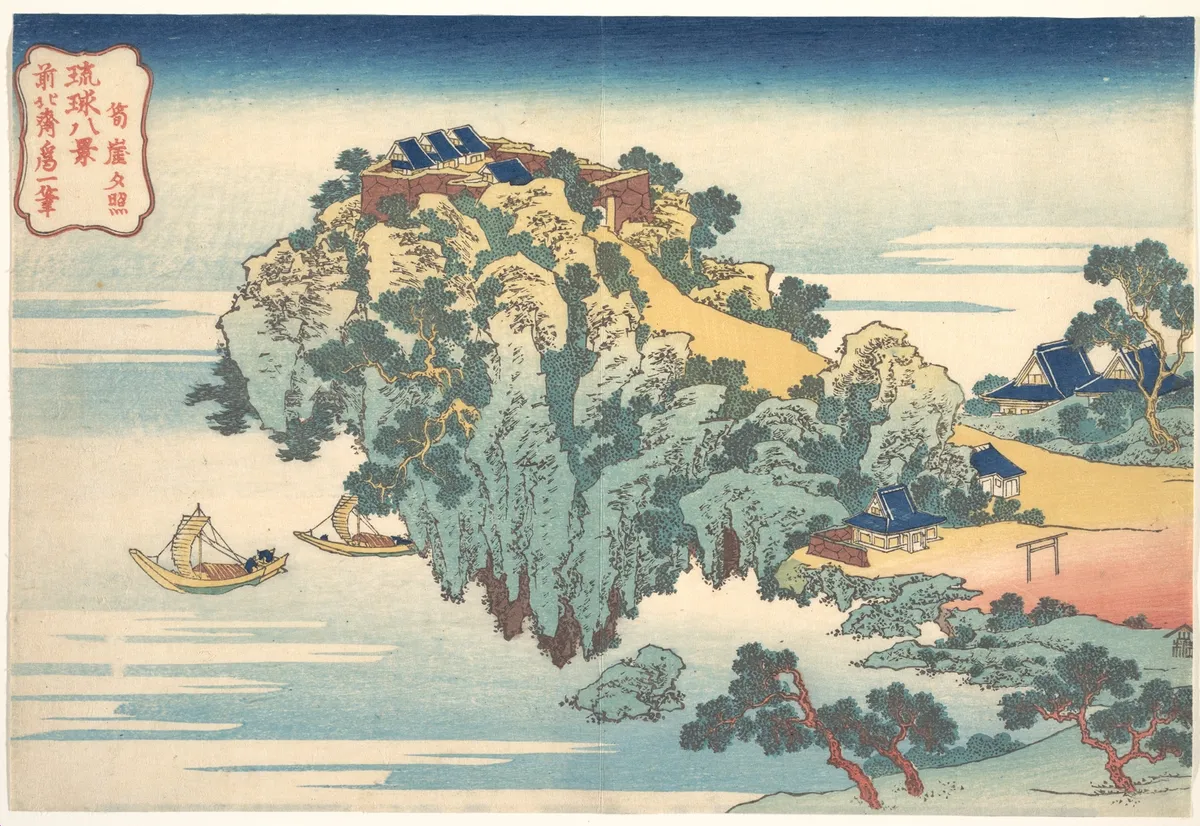
Evening Glow at Jungai
The air is thick with the weight of evening. A soft, amber glow spills over the horizon, casting long shadows that stretch across the water's surface. The Ryūkyū Islands lie quiet beneath the sky, their silhouettes defined against the retreating light. Stillness envelops the scene, broken only by the gentle lapping of waves against the shore.
A lone fisherman stands at the edge of the water, his form dark against the glowing sky. His boat, tethered to the shore, rocks gently with the ebb and flow of the tide. He watches as the sun dips lower, its light flickering like a dying flame. The earth smells of salt and seaweed, a scent carried by the evening breeze.
The sky transforms, hues of orange and purple mingling in the heavens. The fisherman closes his eyes, breathing deeply, feeling the day's warmth slip away. In this moment, time seems to pause, the world holding its breath as night approaches.
Historical Echo
In the early 19th century, Katsushika Hokusai captured the landscapes of Japan and beyond with a masterful eye. "Evening Glow at Jungai" is part of his series "Eight Views of the Ryūkyū Islands," a testament to his fascination with distant places. The print embodies the tranquil beauty and melancholic quietude of twilight, a fleeting moment preserved in ink and paper. In Hokusai's hands, the ordinary becomes extraordinary, a silent echo of a world at rest.