

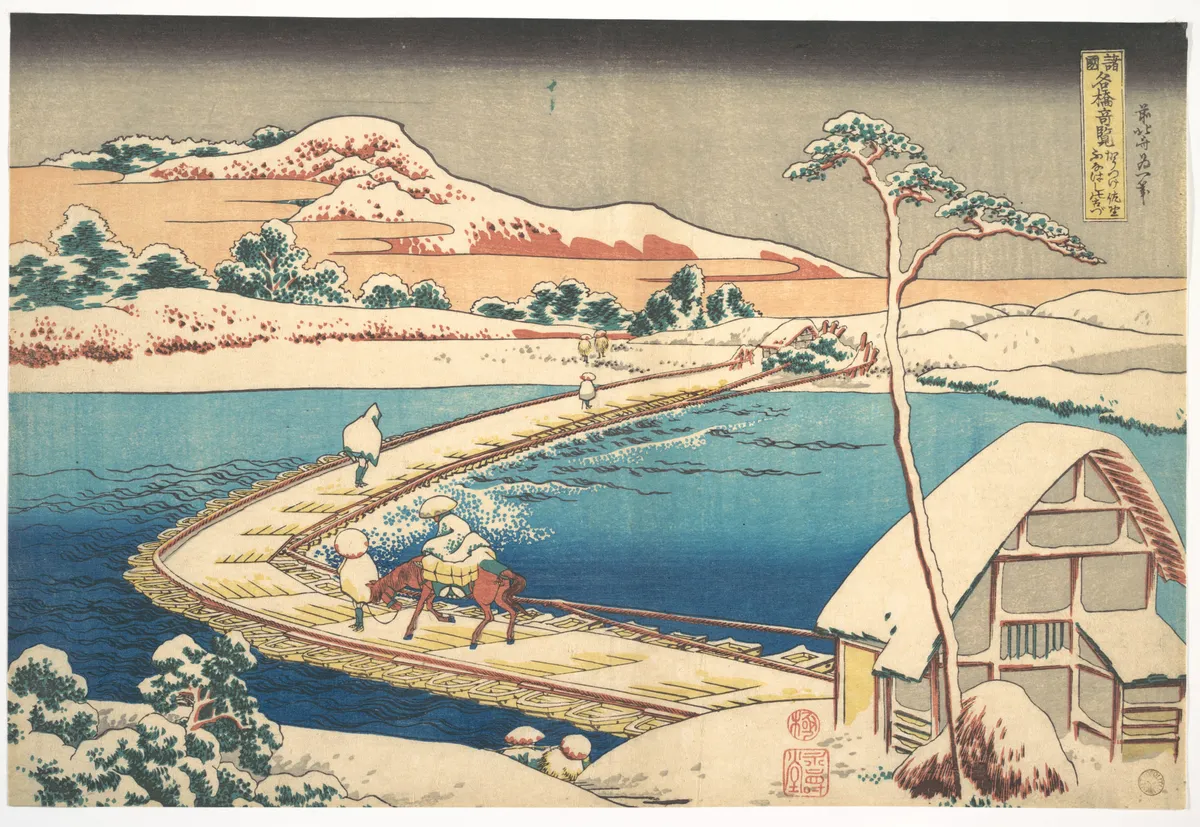
Mist Over Sano
The morning mist clings to the river, a pale shroud over the world. Hokusai captures this moment, where the boat-bridge stretches across the Sano waters. Each vessel, a wooden segment, linked by ropes, sways gently in the current. The air is heavy, moist with the promise of rain.
A lone traveller stands on the bridge. His silhouette is dark against the grey dawn. He pauses, listening to the water's murmur beneath the planks. The distant mountains loom, their outlines softened by mist.
Birds stir in the reeds, their calls sharp in the quiet. The traveller adjusts his cloak, feeling the weight of the damp fabric. He steps forward, the bridge creaking softly, a reminder of its fragile nature.
There is no urgency here, only the slow passage of time marked by each careful step. The bridge is both path and place, a transient meeting of wood and water. Hokusai's lines capture this fleeting stillness, a moment suspended between past and present.
Historical Echo
In the early 19th century, bridges were more than mere crossings in Japan. They were lifelines, connecting provinces, facilitating commerce and connection. The boat-bridge at Sano, depicted by Hokusai, was a marvel of its time. Constructed from boats lashed together, it was a temporary yet vital structure.
Hokusai, renowned for his keen observation, transforms this practical necessity into art. His depiction is not just of a bridge, but of a moment where nature and human ingenuity meet. The mist, the water, the distant mountains—all speak to an Edo period where life moved at the rhythm of nature.
This print is part of Hokusai's series on remarkable bridges. Each piece reflects a unique perspective, a story told through the interplay of line and colour. In "Old View of the Boat-bridge at Sano," we see a world quietly unfolding, a testament to the enduring beauty of the everyday.