

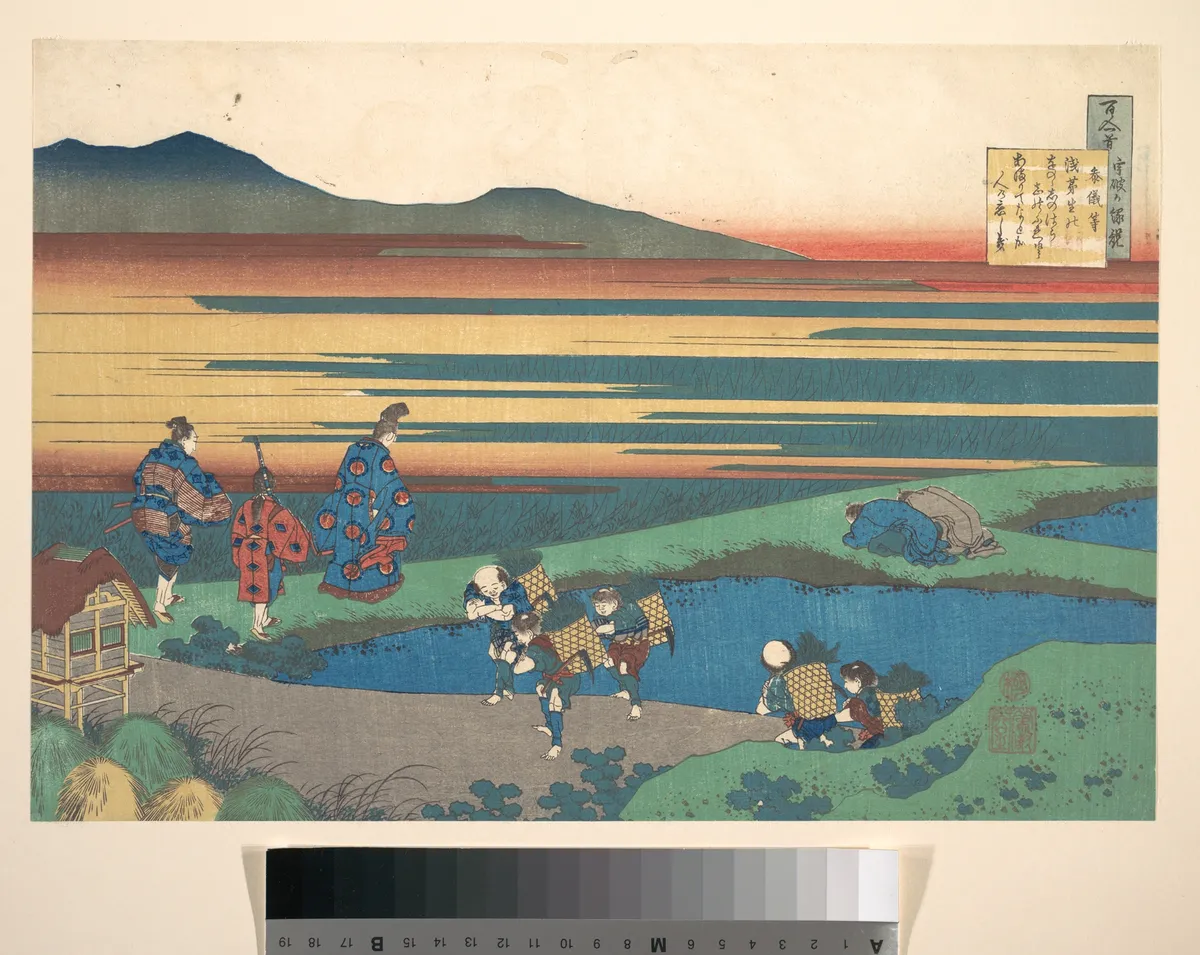
A Quiet Reverie
The air is still. A gentle mist hovers over the landscape, blurring the boundaries between earth and sky. In the distance, mountains rise like ancient guardians, their peaks softened by the morning haze. A lone figure stands at the water's edge, absorbed in contemplation. He is a traveller, his robes heavy with the dew of early dawn. The world around him is hushed, as if holding its breath, waiting for the first light to break.
The poem of Sangi Hitoshi whispers through time, a voice from the past carried on the soft breeze. It speaks of transient beauty, of moments fleeting like the morning mist. The traveller closes his eyes, feeling the weight of centuries in the quietude. His thoughts drift with the current, merging with the ancient words etched in his mind.
As the sun begins its ascent, the mist dissipates, revealing the clarity of the scene. The traveller's silhouette stands stark against the shimmering water. With a quiet sigh, he turns away from the river, his footsteps echoing softly on the path. The poem lingers in the air, a gentle reminder of the ephemeral nature of all things.
Historical Echo
Katsushika Hokusai's depiction of Sangi Hitoshi's poem captures a moment of introspection. The woodblock print is part of his series, "One Hundred Poems Explained by the Nurse." Each piece in the series interprets a classical Japanese poem, weaving together poetry and visual art. Hokusai's work reflects the Edo period's appreciation for literature and the natural world, offering a window into a time where art and poetry were deeply intertwined.