

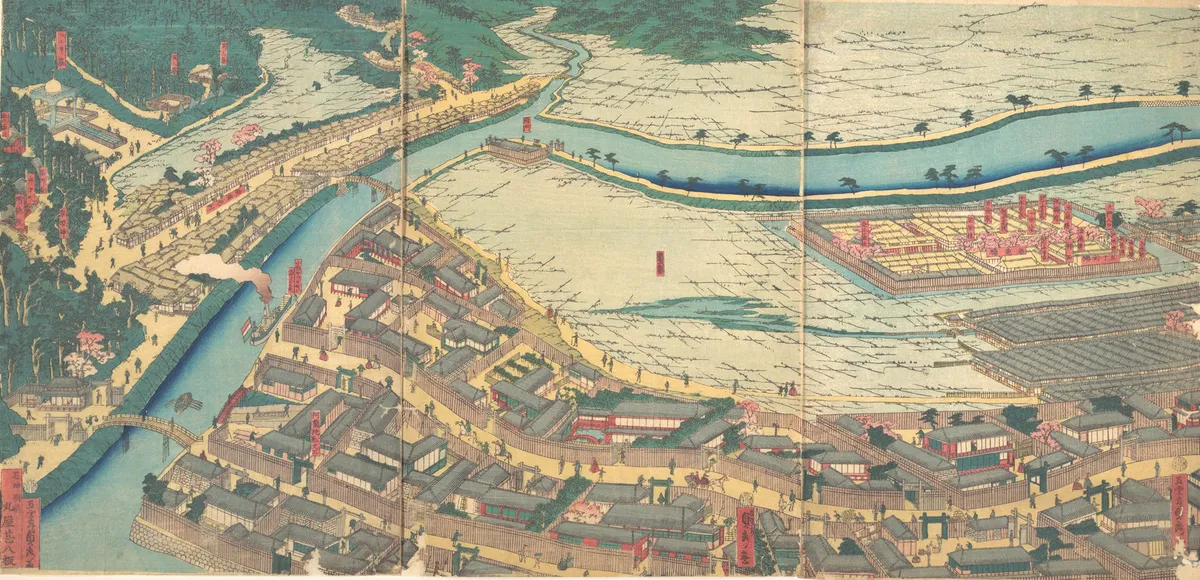
Revised Yokohama
The harbour lies hushed beneath the grey sky. Ships, both foreign and familiar, rest upon the water, their masts piercing the mist. Sailors move with quiet purpose, their boots tapping softly against the wooden docks. The air is thick with the scent of salt and distant lands.
Among the figures, a woman stands still. Her kimono whispers in the breeze, patterned with waves that mimic the sea's gentle undulations. She watches a ship, its flag unfurling—a strange, colourful emblem from across the ocean. The harbour reflects the clash and blend of worlds, of traditions meeting the unknown.
A merchant haggles nearby, his voice a low rumble, rising and falling like the tide. His wares, a medley of East and West, tell stories of the journeys they have made. Porcelain glints alongside brass instruments, silk mingles with wool, each item a bridge between shores.
Laughter drifts from a cluster of travellers, their languages a mosaic of sound. Children chase one another, heedless of the complexity surrounding them. Their footsteps echo the heartbeat of the port, a rhythm of life and commerce.
Above it all, gulls wheel and cry, their calls sharp against the soft murmur of the crowd. The city of Yokohama breathes, expanding with each new arrival, contracting with each departure, ever poised on the cusp of change.
Historical Echo
Yokohama, once a quiet fishing village, transformed in the mid-19th century. The Treaty of Kanagawa opened its port to the world, ushering in an era of trade and exchange. Utagawa Sadahide captured this moment of transition. His prints reflect the mingling of Japanese tradition with Western influence, a visual diary of cultural convergence. In 1861, Yokohama was a stage where the familiar and the foreign danced in tentative harmony. Sadahide's portrayal of this landscape is not just a scene, but a testament to a world reshaping itself in the face of modernity.