

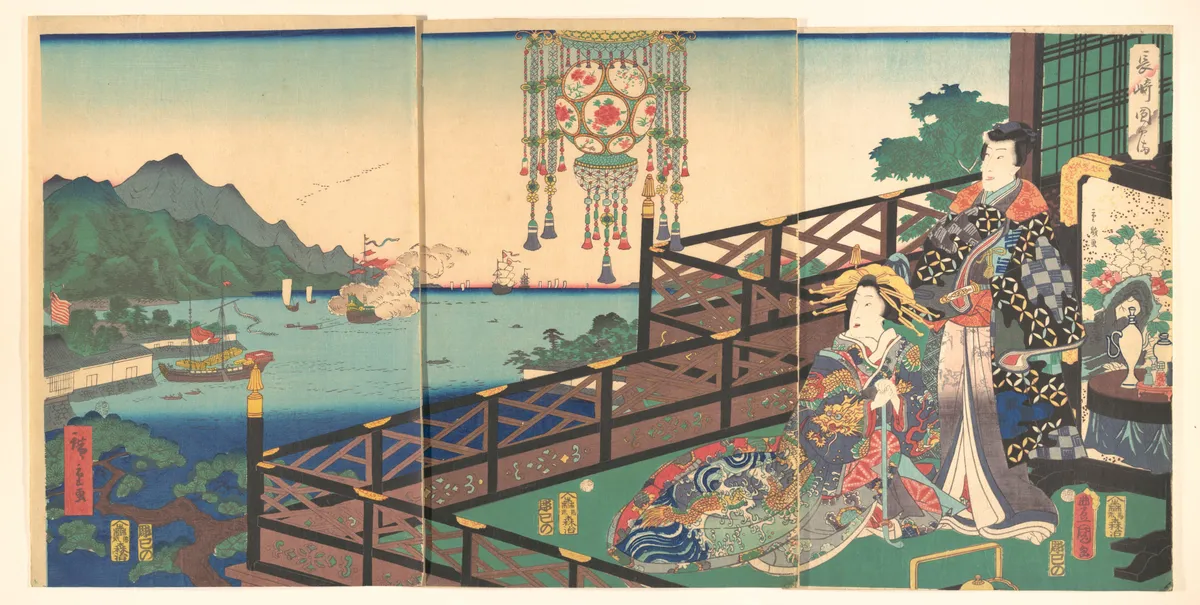
Mitsuuji's Silent Night
In the heart of Nagasaki's Maruyama, shadows flickered beneath the paper lanterns. Mitsuuji stood, poised, beneath a cherry tree. The air was thick with the scent of blossoms, mingling with distant laughter. He adjusted his kimono, its silk heavy against the cool night. Around him, the pleasure district whispered secrets in the dark.
Footsteps echoed softly on the stone path. Women in vibrant kimonos moved like phantoms, their laughter a gentle breeze. Mitsuuji watched them, a silent observer, his face partially hidden by the brim of his hat. The night held a certain weight, a heaviness that pressed against the skin.
A shamisen played somewhere in the distance, its notes weaving through the air like a delicate thread. Mitsuuji's eyes followed the sound, drawn to its melancholic tune. He stepped forward, his movement smooth, like a shadow slipping through the night.
The lanterns above swayed in a gentle breeze, casting a dance of light and shadow across the ground. Mitsuuji paused, his gaze lingering on the silhouettes that moved around him. Each figure a story, each step a memory etched in the quiet of the night.
He inhaled deeply, the cold air filling his lungs. The world around him seemed to pause, holding its breath in the stillness. Mitsuuji was a part of it, a fragment of the night, a watcher in the world of fleeting beauty.
Historical Echo
In 1861, Nagasaki's Maruyama district thrived as a centre of entertainment. The ukiyo-e master Utagawa Kunisada captured this world with precision. Here, the pleasure district was a realm of transient joys and hidden sorrows. Mitsuuji, a figure from Japanese literature, stands amidst this backdrop, embodying the era's fascination with beauty and ephemerality. The print reflects a moment frozen in time, where the past lingers in the shadows of the night.