

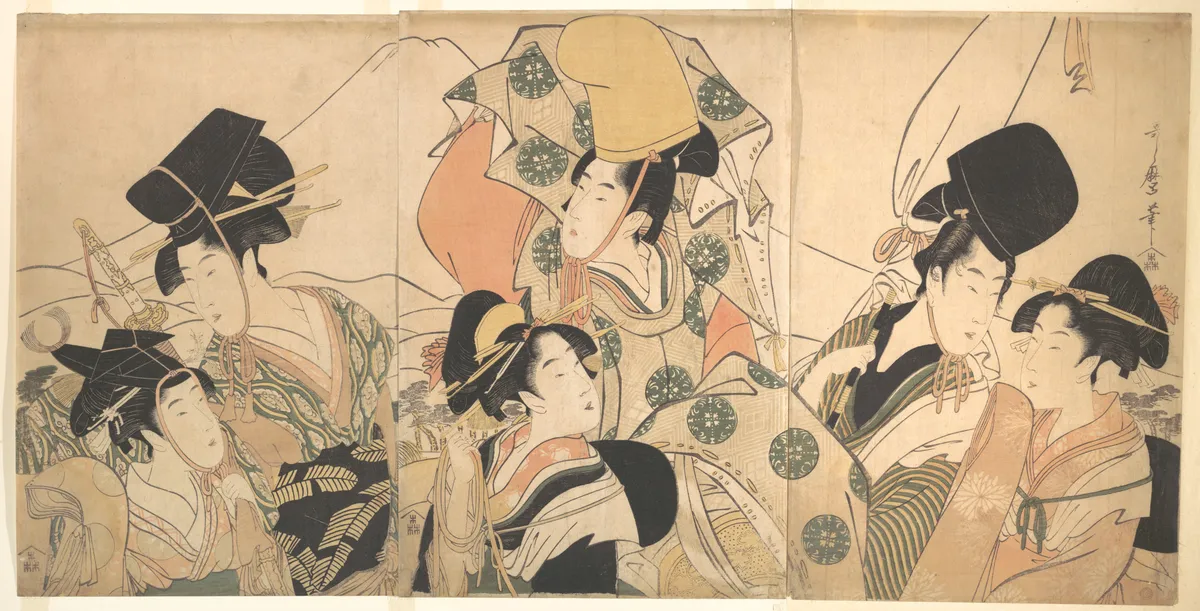
Narihira’s Journey to the East
The air is thick with anticipation. Narihira stands at the edge of the world he knows. The path before him is a ribbon unfurling into the unknown. His robes whisper against the earth as he moves. The sky is a muted grey, promising neither fair weather nor storm. He pauses, listening to the distant rustling of leaves, a sound that speaks of both departure and return.
Behind him, whispers of court life linger, like the fading notes of a distant biwa. Ahead, the road eastward calls, carrying rumours of landscapes unseen, mountains that pierce the heavens, rivers that cut through valleys like ink on silk. Narihira's heart beats in time with his footsteps, steady, resolute.
His companions, faces shadowed under wide-brimmed hats, move silently beside him. They are figures etched in the soft light of dawn, their presence a comfort against the vastness of the journey. Each step takes them further from the familiar, yet closer to something profound, a truth hidden in the folds of the landscape.
The scent of pine lingers in the air, mingling with the distant promise of the sea. It is a moment suspended in time, captured by Utamaro’s delicate hand, an echo of a journey that transcends mere travel. It is a pilgrimage of the soul, a dance with the unknown.
Historical Echo
Narihira, a legendary poet of the Heian period, is said to have journeyed eastward, seeking solace and inspiration. The depiction by Utamaro captures the essence of this journey, a blend of reality and myth. Utamaro’s work reflects the Edo fascination with historical and literary figures, drawing viewers into a world where past and present intertwine. The print serves as a window into not just a physical journey, but a spiritual quest, inviting contemplation of the paths we all must walk.