

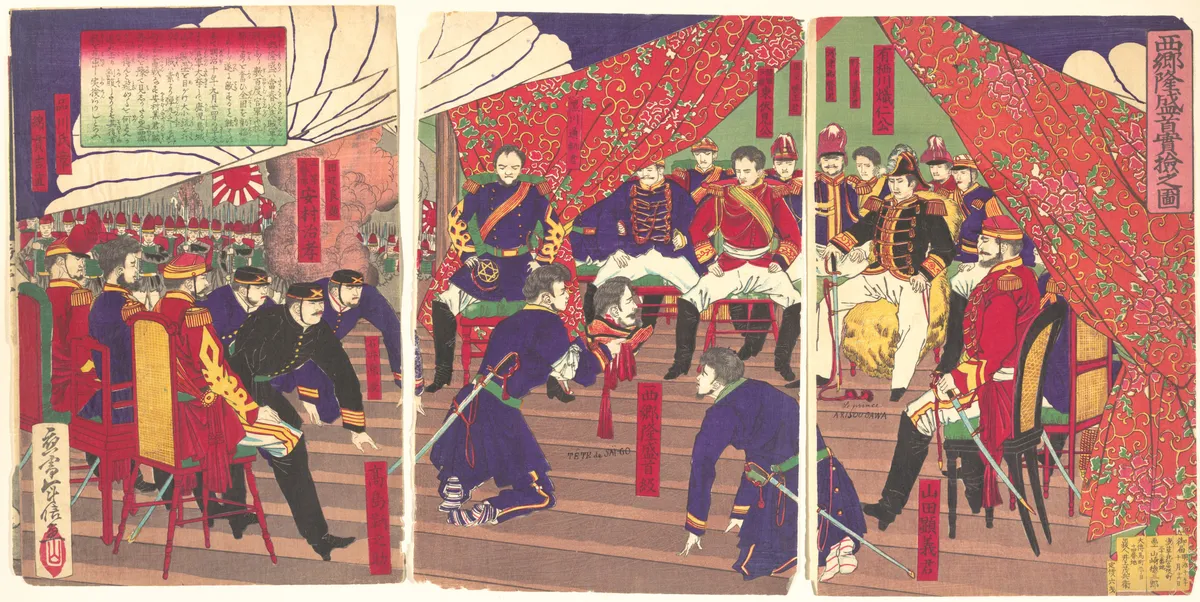
Presentation of the Head
Night wrapped the camp in silence. A single lantern burned. Its light trembled on the polished wood floor. The air was thick with the scent of pine and blood.
A group of men entered. Their footsteps were heavy, echoing between the paper walls. At their head was a soldier carrying a wooden box. His face was set, his eyes shadowed.
Prince Arisogawa waited, seated on a tatami mat. His posture was rigid. The flickering light caught his armour, making it gleam like wet stone.
The soldier knelt. Carefully, he placed the box before the prince. No words were spoken. The room held its breath.
Slowly, the prince reached out. His fingers brushed the lid. It opened with a soft creak. Inside lay the head of Saigo Takamori. It was freshly severed, eyes closed as if in sleep.
The prince gazed at it, his expression unreadable. A shiver passed through the air. Outside, the wind sighed through the trees.
A moment stretched, taut and silent. Then, with a nod, the prince acknowledged the end of rebellion. The box was closed. The lantern flickered and dimmed.
The men rose and departed, leaving the prince alone with his thoughts. The night resumed its quiet vigil. Only the pine and the blood remained.
Historical Echo
This scene captures a moment of finality in the Satsuma Rebellion. Saigo Takamori, revered as the "last true samurai," had led the revolt against the Meiji government. His defeat marked the end of an era.
Prince Arisogawa, a representative of the imperial cause, received Saigo's head as a symbol of victory. Yet, the print reflects more than triumph. It conveys the weight of loss, the somber passage of history.
Yamazaki Toshinobu's work, created in 1877, resonates with the melancholic echoes of tradition yielding to modernity. The woodblock print embodies the tension between past and future, the silence of honour and the noise of change.