

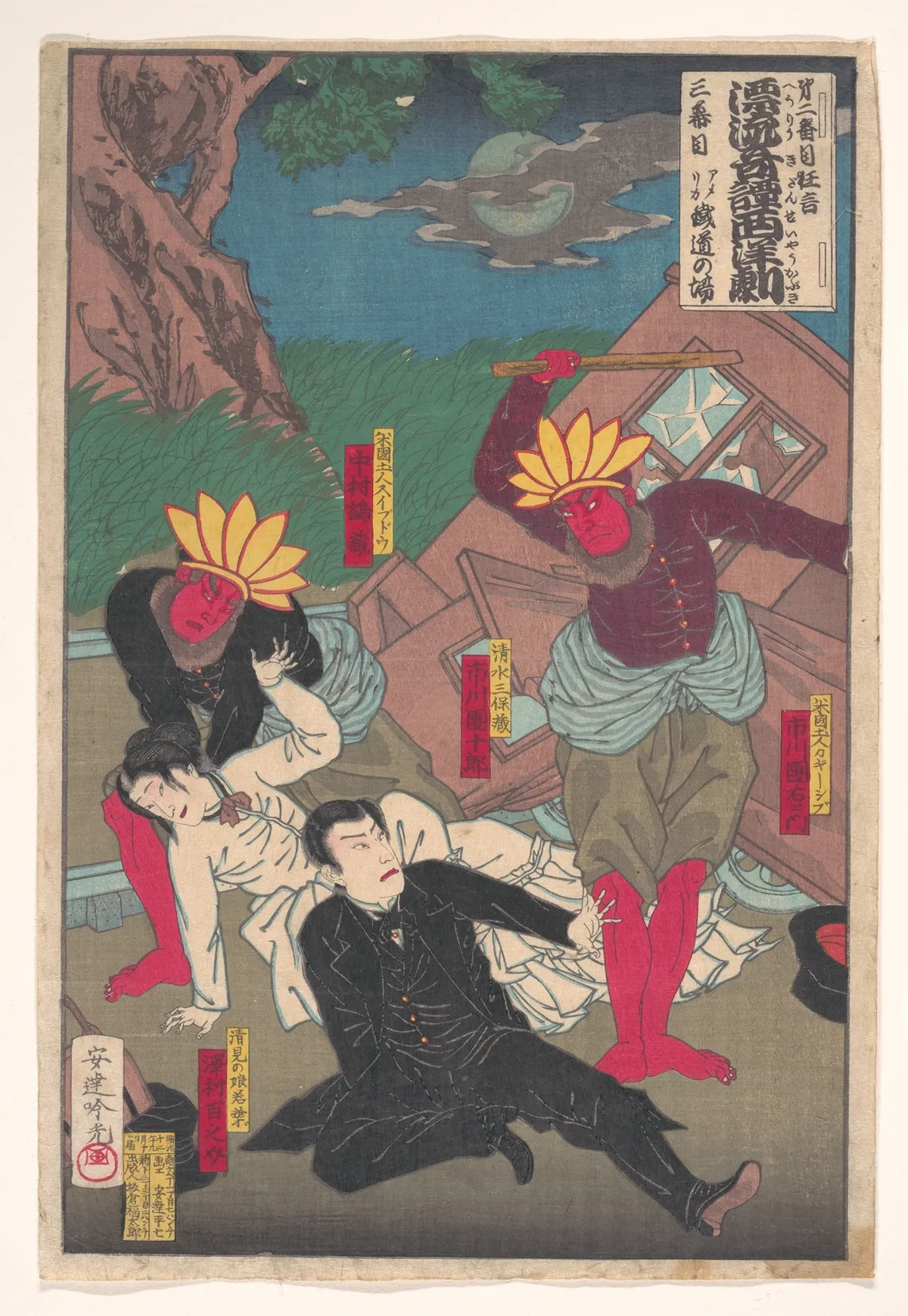
Castaways on the Iron Path
The steel rails gleamed under the pale American sun. A chill wind whispered through the sparse grass. Along the endless path, the castaways moved. Their feet scuffed the gravel. They wore the dust of a world far from home. A woman, her kimono incongruous against the foreign landscape, paused. She turned her head, listening. The distant rumble of an approaching train was a low growl in the earth. Her companions, men in heavy coats, exchanged glances. The air was thick with uncertainty.
A whistle pierced the air, shrill and urgent. The train, a beast of iron and steam, emerged. It clattered along its course. The ground vibrated beneath their soles. The woman's eyes widened, reflecting the monstrous contraption. Her hand clutched the fabric at her chest. Time stretched and contracted with each beat of her heart.
As the train roared past, its smoke curled into the sky, leaving a trail of soot and echoes. The castaways stood silent, their breath visible in the cold air. The world resumed its quiet. Only the fading clatter remained, a memory of the encounter.
They resumed their journey, footsteps heavy along the tracks. The horizon stretched before them, vast and unknown. Behind them, the train's cry lingered, a reminder of their place in this foreign land.
Historical Echo
In 1879, Adachi Ginkō captured a moment of cultural intersection. This ukiyo-e print depicts a scene from "The Strange Tale of the Castaways: A Western Kabuki." It reflects the Meiji era's fascination with Western technology and landscapes. The presence of Japanese figures against an American backdrop speaks to a time of transition and exploration. The train, a symbol of industrial progress, contrasts with traditional attire, highlighting the era's juxtaposition of old and new. The print serves as a testament to the artistic dialogue between Japan and the West during this period.