

The Stage's Silent Pulse
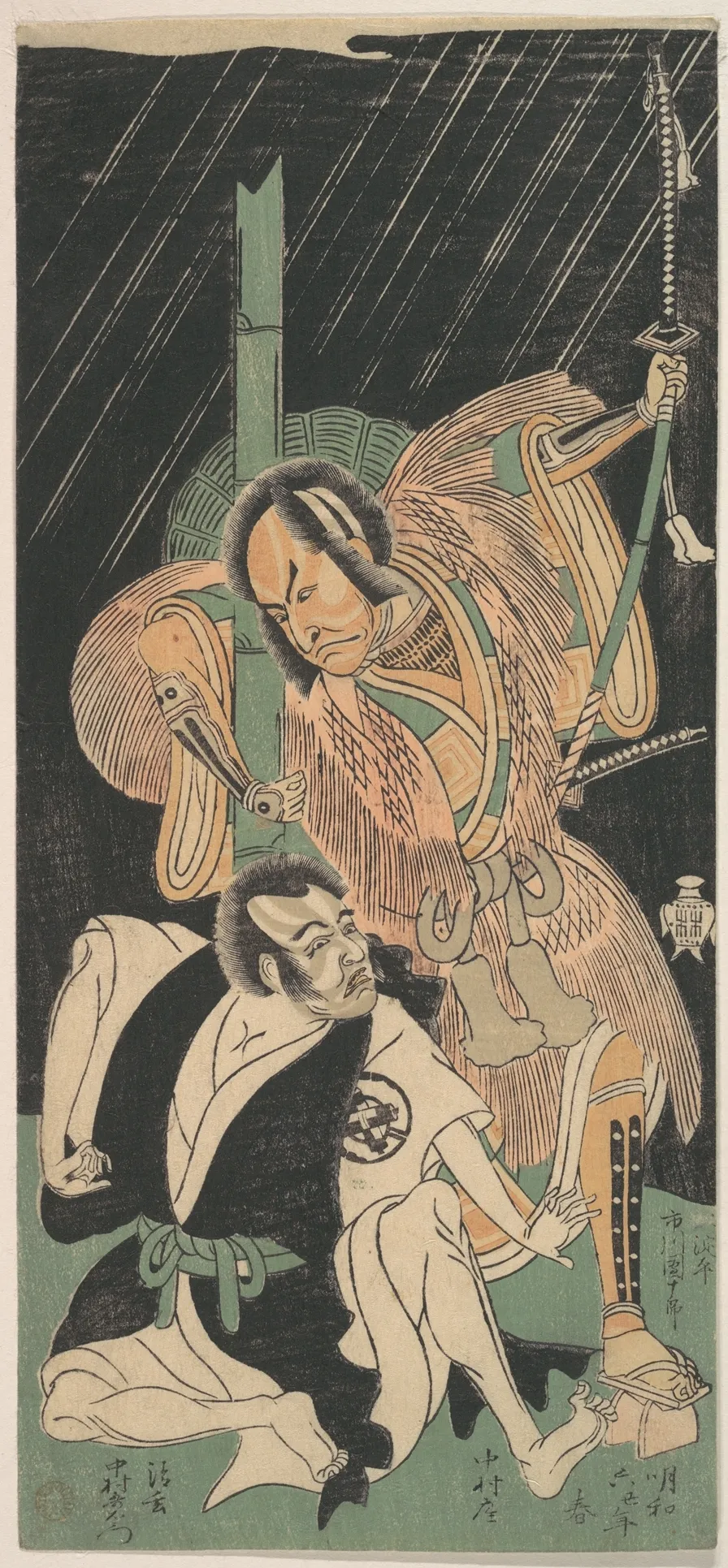
The stage breathed quietly beneath the flickering lanterns. Shadows stretched long across the wooden boards, tracing the contours of two figures. Ichikawa Danjūrō IV stood as Yakko Yodohei, his posture rigid yet fluid, like a coiled spring. The air around him was taut with anticipation. Each fold of his costume held stories untold, whispers of past performances echoing in its fabric.
Beside him, Nakamura Utaemon I embodied the monk, Kiyomizu no Seigen. His presence was a calm contrast, serene yet commanding. The heavy robes he wore muffled his movements, yet his eyes were alive with silent intensity. Between them, an unspoken dialogue simmered, the tension palpable yet controlled.
The audience held its collective breath. Time seemed to slow, each second a heartbeat of expectation. The actors' painted faces gleamed under the soft glow, capturing the delicate balance of their craft. The quiet rustle of silk and the creak of the wooden stage were the only sounds, a symphony of restraint.
In this suspended moment, the boundaries between art and life blurred. The kabuki theatre, with its vibrant colours and dramatic narratives, became a living entity, its pulse synchronised with the breaths of those within its embrace.
Historical Echo
In 1769, during the Meiwa era, Katsukawa Shunshō captured this moment in woodblock form. The actors, Ichikawa Danjūrō IV and Nakamura Utaemon I, were renowned for their ability to transform the stage into a realm of myth and reality. Their performances were not mere entertainment but a reflection of Edo's cultural heartbeat.
Shunshō's depiction immortalises this, offering a glimpse into the world of kabuki, where each gesture and glance carried the weight of storytelling. This print, beyond its artistic merit, stands as a testament to the era's theatrical ingenuity and the enduring legacy of its performers.