

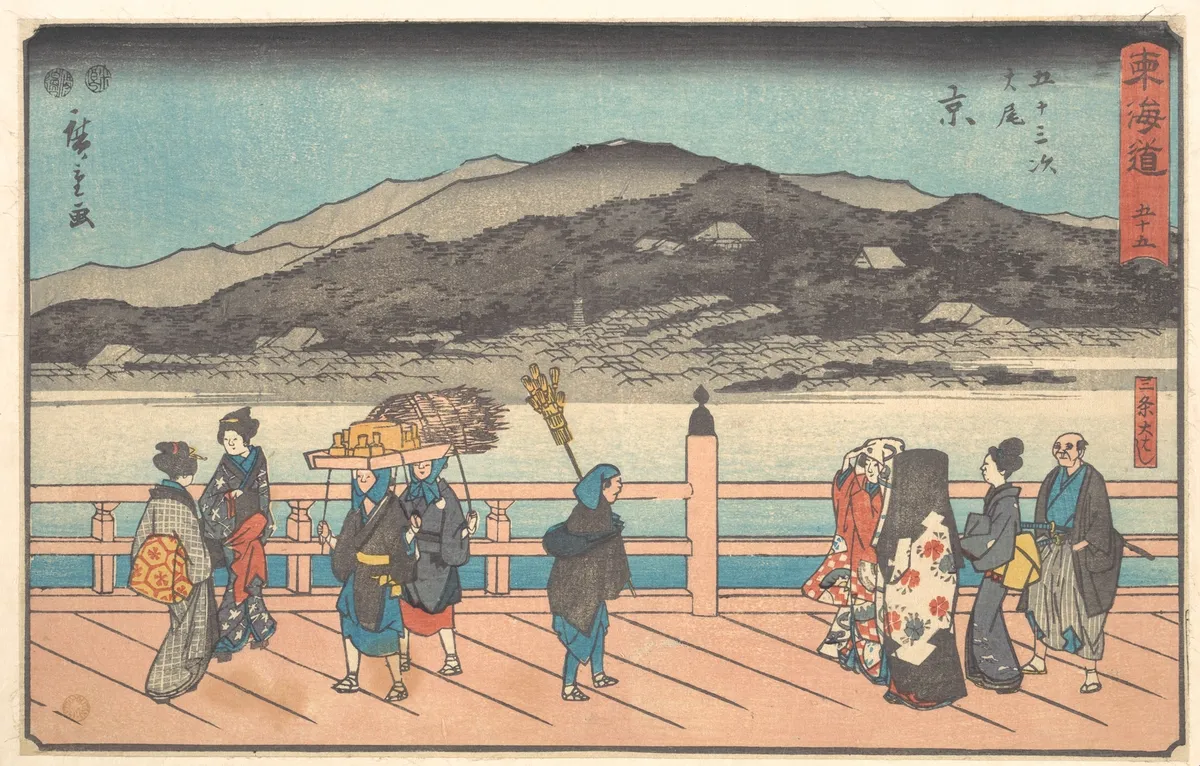
The Great Bridge at Sanjō
Light mist hovers over the Kamo River. The air is thick with morning dew. Sanjō Ōhashi stretches across the water, a wooden spine connecting the banks. A faint creak of wood echoes as footsteps pass. Travellers, cloaked in indigo-dyed garments, tread with purpose. Their sandals whisper against the planks. A cool breeze dances, stirring the hems of kimonos, carrying the scent of damp earth and distant pine.
The river flows silently beneath, reflecting the muted colours of the sky. A lone boat drifts nearby, its silhouette barely discernible in the early light. On the bridge, a vendor pauses, rearranging his wares. His hands move deftly, accustomed to the rhythm of daily trade. Nearby, a child laughs, breaking the stillness. Her voice is a clear note in the morning air.
Above, the sky begins to open, revealing hints of blue. The city stirs, awakening to the day. Sanjō Ōhashi stands steady, a silent witness to countless crossings. Each step, each breath, a part of the bridge's enduring story.
Historical Echo
Sanjō Ōhashi, the great bridge of Kyoto, is more than timber and nails. It is a passage through time, a witness to the ebb and flow of life during the Edo period. Built as a part of the Tōkaidō road, it connected Kyoto to the vast expanse of Japan. This bridge bore the weight of countless travellers—merchants, samurai, peasants—each with stories etched in their journey. In Hiroshige’s portrayal, the bridge is alive, echoing the quiet persistence of those who walked its length. The wood, the river, the sky—all hold memories of an era long past, yet still present in the quiet corners of history.