

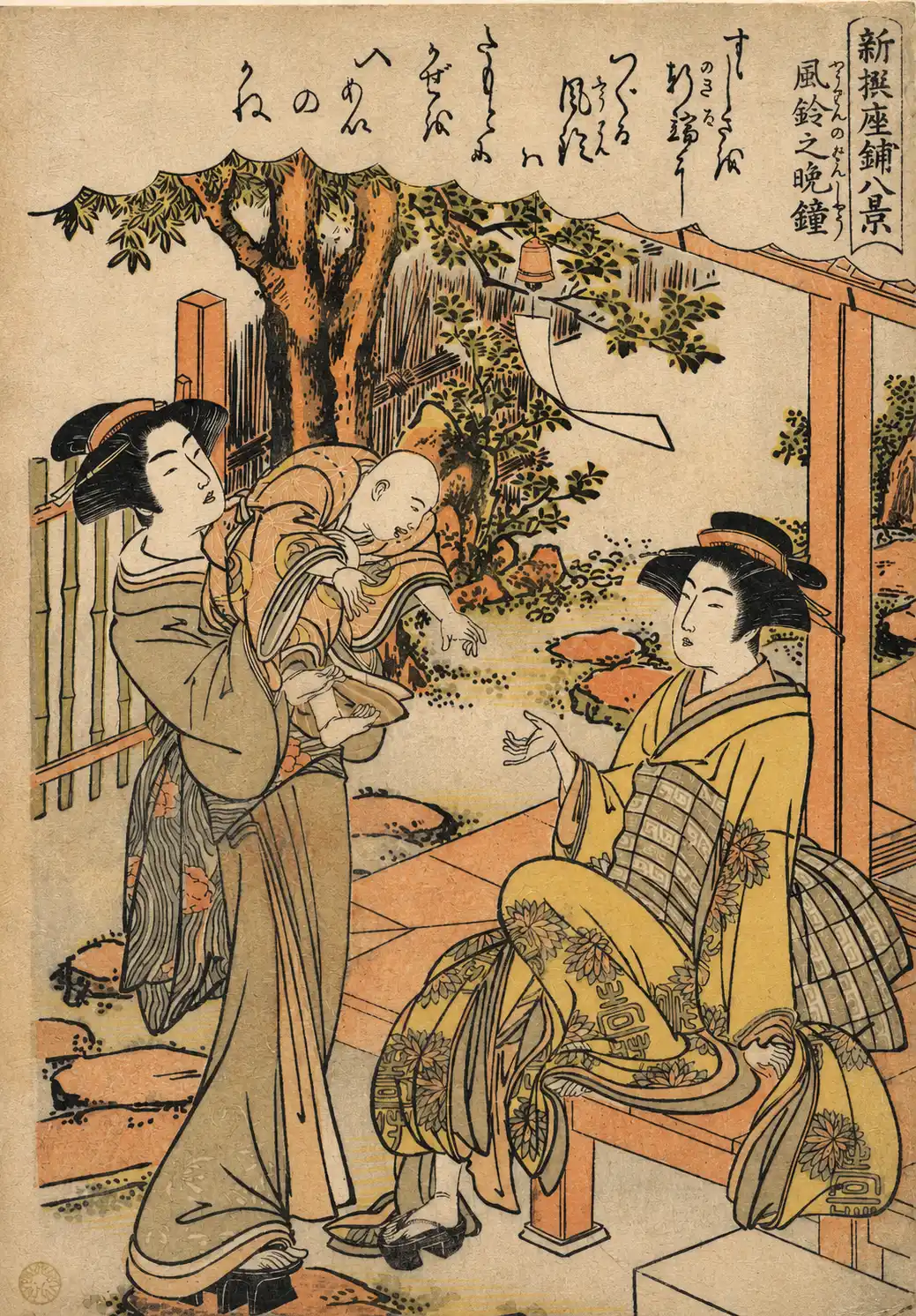
The Evening Wind-bell
A soft chime breaks the evening silence. The wind-bell sways gently under the eaves. A woman stands quietly, her silhouette framed by the warm glow of lantern light. Her kimono whispers as she moves, fabric brushing against the tatami. The air is thick with summer's heat, yet the breeze carries the scent of distant rain. Her fingers brush the bell's cord, feeling its coolness, listening to its voice. The world outside is hushed, waiting. Inside, shadows play on paper walls, flickering with the candle's flame. She gazes into the night, where fireflies dance like distant stars. Her mind wanders with the wind, to places far and near, to moments remembered and forgotten. The night deepens, the bell tolls softly, marking time with each gentle swing. In this quiet hour, the world is wide and still.
Historical Echo
Kitao Masanobu, known also as Santō Kyōden, was a master of capturing the fleeting beauty of the Edo period. In "The Evening Wind-bell," created around 1783, he evokes an intimate moment. The wind-bell, a simple object, becomes a symbol of transience. It resonates with the quietude of evening, the gentle passage of time. During this era, such images of women, or bijin, were popular, celebrating grace and serenity. The scene is both ordinary and profound, a glimpse into the private world of Edo's past.