

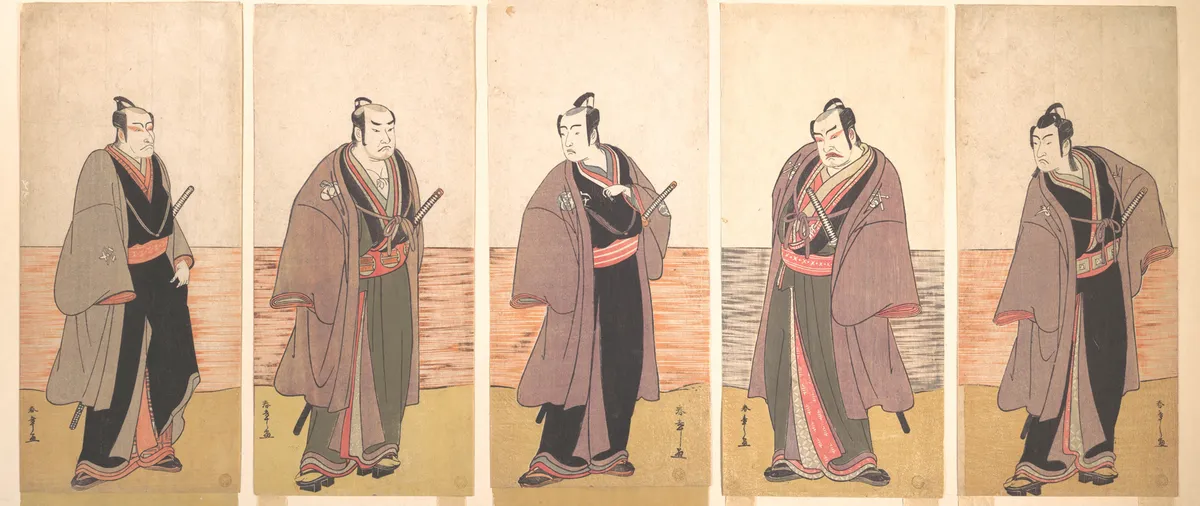
The Chivalrous Commoner
The lantern flickers against the paper walls. Shadows dance as Ichikawa Danjuro V steps onto the stage. His kimono rustles softly, heavy with the weight of its fabric. The air is thick with anticipation.
He embodies the chivalrous commoner, Gonin Otoko, from the play "Hatsumonbi kuruwa Soga". The audience holds its breath. His expression is fierce, eyes sharp like blades. A hush falls over the theatre. Only the distant sound of the rain can be heard, tapping gently on the roof.
His voice cuts through the silence, commanding and deep. It resonates with the tales of loyalty and honour. The scent of incense mingles with the mustiness of the old wood. The audience is spellbound, caught in the web of his performance.
Every gesture is deliberate, calculated. The flick of his wrist, the tilt of his head. It’s as if time stands still, each moment stretching into eternity. The light flickers again, casting long shadows.
Here, in this moment, the boundaries between actor and character blur. Ichikawa Danjuro V is not merely performing; he is living the role. The commoner stands defiant, noble.
Historical Echo
In February 1780, the celebrated actor Ichikawa Danjuro V took on the role of Gonin Otoko. This was a time when Kabuki theatre was thriving. The stage was a place of transformation, where reality and fiction entwined. Katsukawa Shunshō, a master of capturing the essence of the theatre, immortalised this moment in a woodblock print. The print reflects the vibrancy of the Edo period. It echoes the stories of courage and honour that resonated deeply with its audience. Each line and colour in the print carries the weight of history, a testament to the enduring allure of Kabuki.