

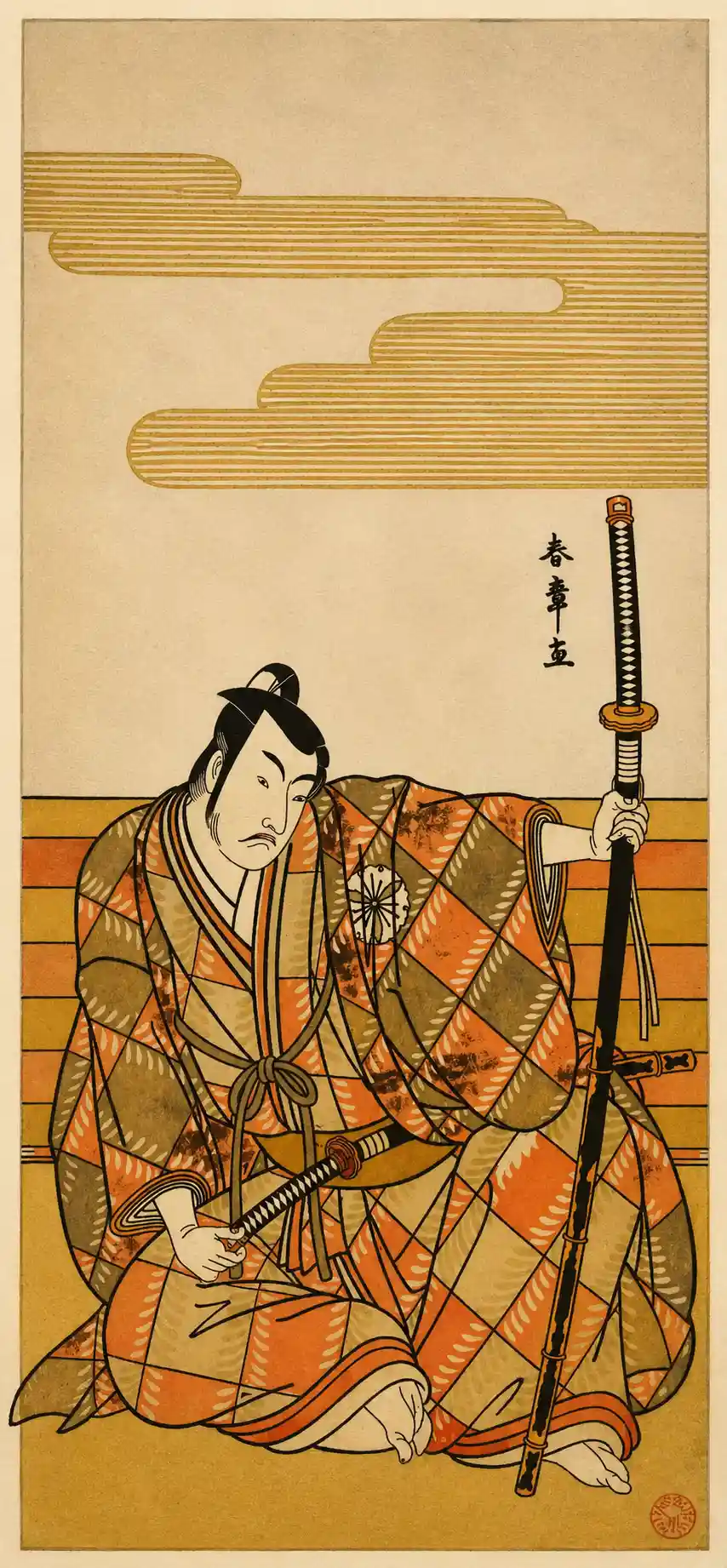
The Fourth Matsumoto Koshiro as a Samurai
The paper rustles in a faint breeze, carrying the scent of pine. Matsumoto Koshiro stands firm, his silhouette sharp against the dim glow of lantern light. His armour catches the light, metal plates glinting like silent whispers. The air is heavy with an unspoken tension, the night still, save for the distant murmur of the river. He grips his katana with a steady hand, the blade an extension of his resolve. His eyes, shadowed beneath the helm, are fixed, yet carry a softness, a hint of the man beneath the warrior's guise.
The stage is set, a kabuki theatre of shadows and echoes. The audience, cloaked in the quiet of anticipation, breathes as one, their presence a muted hum in the night. Matsumoto Koshiro, the fourth of his line to bear the name, embodies the spirit of a samurai, his movements a dance of tradition and honour. Beneath the layers of paint and fabric, he becomes a timeless figure, a living canvas of Katsukawa Shunshō's art.
Each step, a whisper on the wooden boards, tells a story older than the man himself. The samurai pauses, the moment suspended in an eternity of ink and paper. The world holds its breath, as if afraid to disturb the delicate balance between reality and performance.
Historical Echo
In the late Edo period, kabuki theatre thrived, a world where actors like Matsumoto Koshiro became legends. Katsukawa Shunshō, renowned for his ukiyo-e portraits, captured these luminaries with precision and grace. His work immortalised the intersection of art and life, where actors donned the roles of samurai, blurring the lines between the stage and reality.