

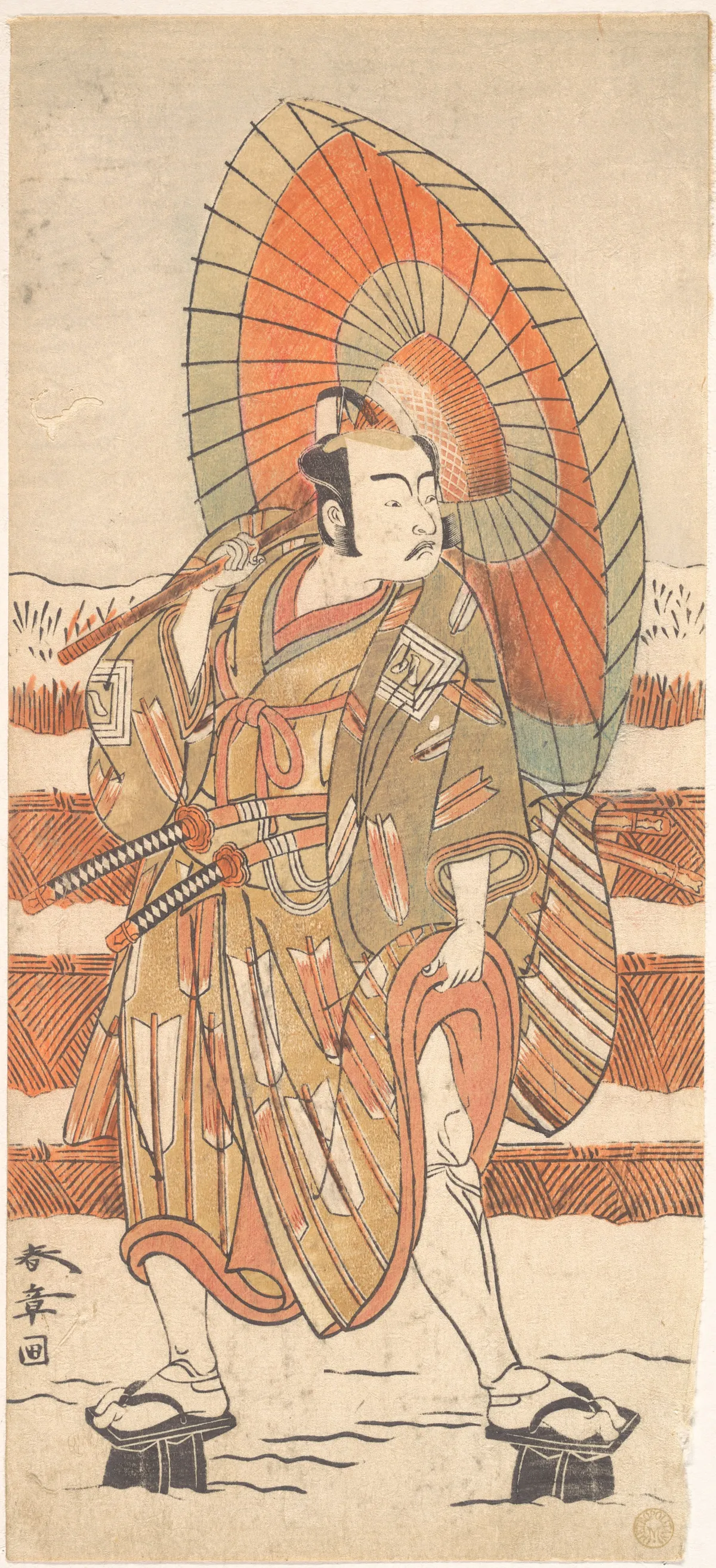
Silent in the Snow
The air was heavy with the promise of more snow. Each flake fell slowly, gently, muffling the world in white silence. The samurai stood alone, his form rigid against the cold. His name was Ichikawa Yaozo, second of his line, a figure known on stage and beyond. The snow whispered around him, clinging to his robes, turning his silhouette into a ghost of itself.
His kabuki costume was a riot of muted colours, now softened by the snow. The weight of his swords pulled slightly at his waist, a comforting presence in the desolate landscape. He relished the solitude, the moments before the play began, when the world was his alone.
A distant echo of a drumbeat cut through the stillness. The theatre awaited, its lanterns glowing faintly in the distance. Yaozo exhaled, his breath visible in the frigid air. He moved forward, each step crunching softly underfoot, the snow bending beneath his sandals.
The audience would soon see him not as a man but as a character, a warrior from another time. But here, in the quiet, he was simply Yaozo, feeling the chill seep into his bones, the snow’s icy caress on his cheeks.
The world, for a moment, was nothing but snow and silence.
Historical Echo
In the bustling world of Edo's kabuki theatres, Ichikawa Yaozo II was a renowned actor. Katsukawa Shunshō captured him here, a samurai in snow, likely around 1774. The woodblock print reveals the intersection of theatre and life, where actors became legends. In this frozen moment, the boundaries blur, and the actor stands timeless, a samurai in both spirit and art.