

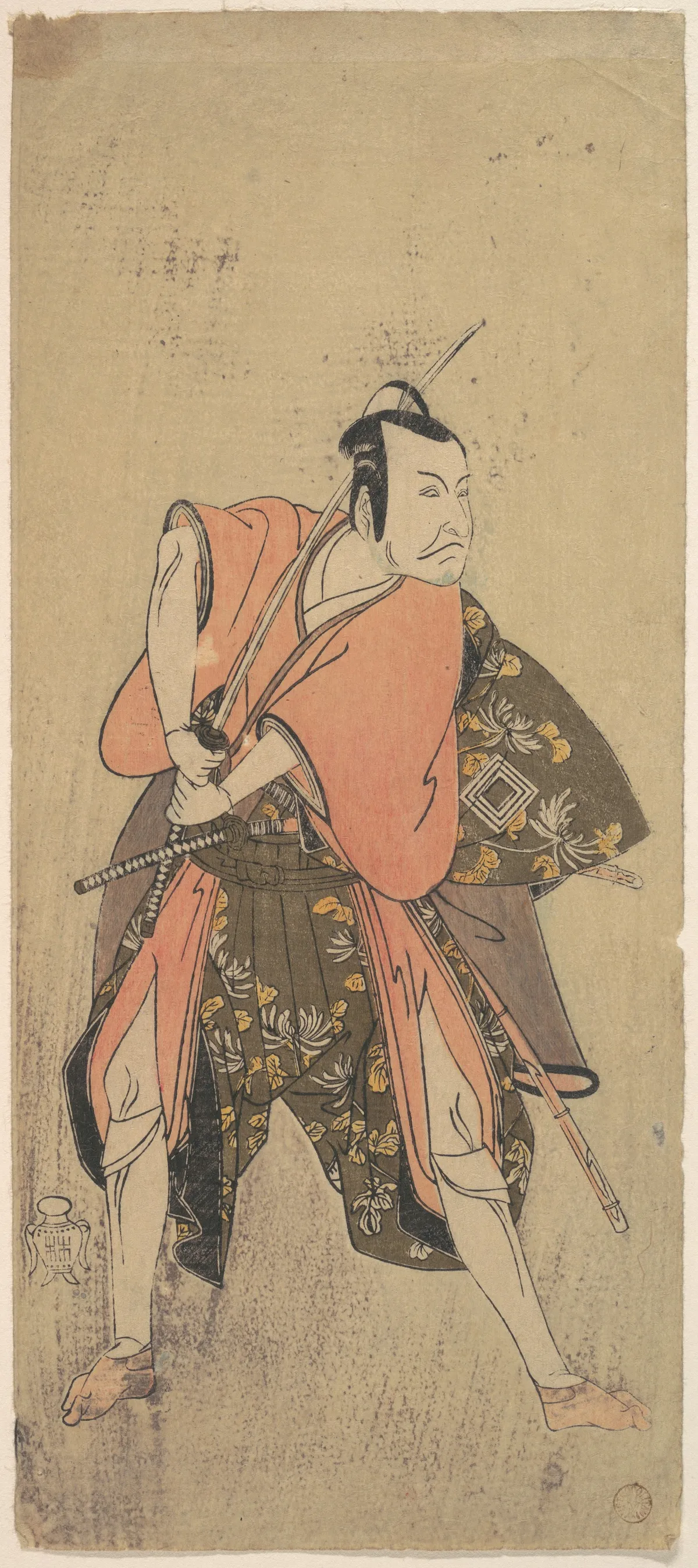
The Actor's Poise
The air was heavy with anticipation. A lone figure stood on the stage, the actor Ichikawa Danjuro V. He was draped in the flowing robes of a samurai. His expression was one of fierce determination. The audience watched in silence, their eyes fixed on his every move. The stage was dimly lit, shadows playing across his face. The fabric of his costume rustled softly with his every breath. In his hand, he held a gleaming sword, its blade catching the faint light. The weight of the weapon seemed to anchor him, grounding him in the role he was born to play.
A subtle scent of incense lingered in the theatre, mixing with the musty smell of aged wood. The air was thick, almost tangible. As he shifted his stance, the sound of his feet against the wooden floor echoed softly. The anticipation was palpable, a living thing that thrummed through the room. Each audience member held their breath, caught in the spell of his presence.
In that moment, Ichikawa Danjuro V was not just an actor. He was the embodiment of the samurai spirit, a living echo of a time when honour and duty were life itself. The silence stretched, unbroken, as he prepared to strike. The scene was set; the story told through the silence, through the poised tension in his limbs.
Historical Echo
Ichikawa Danjuro V was a famed kabuki actor, renowned for his powerful performances. In the Edo period, kabuki was more than entertainment; it was a reflection of societal values and historical narratives. The samurai roles were particularly revered, embodying ideals of honour and bravery. Katsukawa Shunshō, the artist, captured this essence in his prints, preserving the transient art of theatre in a permanent form. In this print, Danjuro's portrayal of a samurai ready to fight becomes a timeless memory, a testament to the enduring allure of the warrior spirit. The woodblock print, created around 1771, remains a vivid reminder of the cultural and historical tapestry that defined an era.