

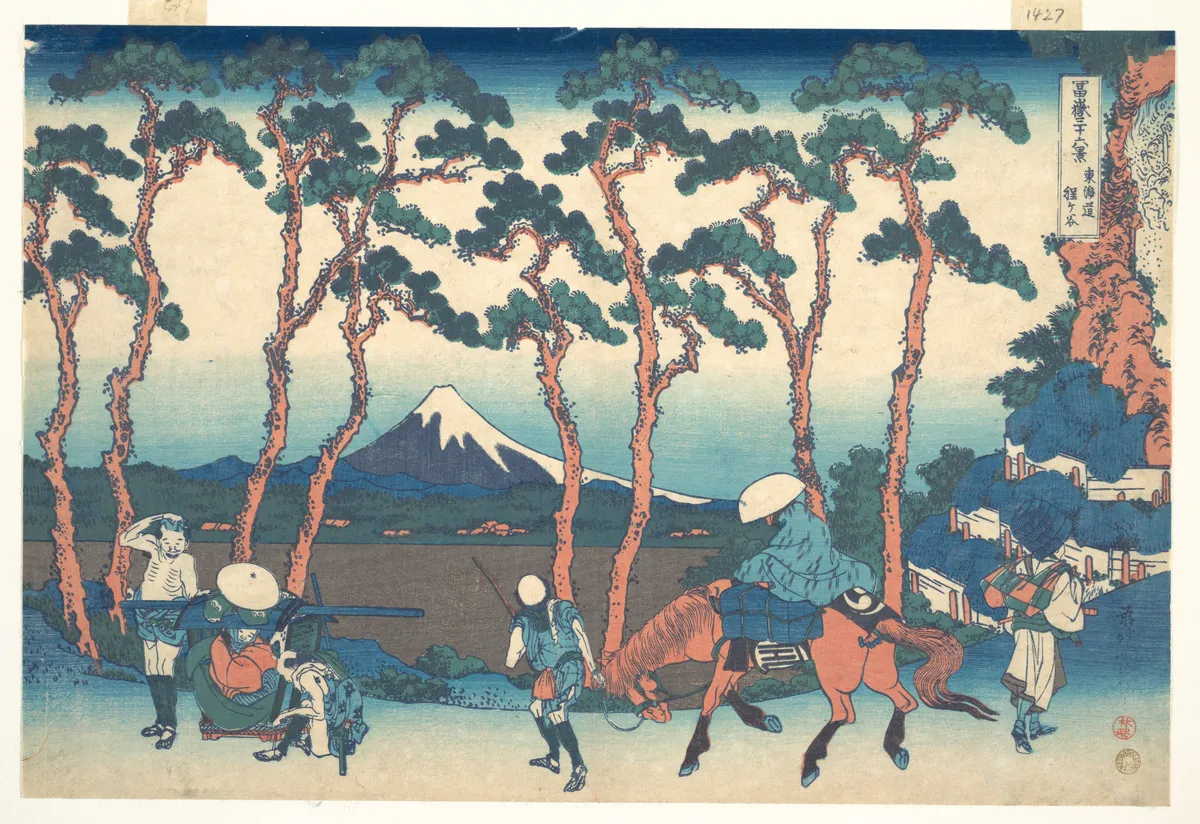
Hodogaya on the Road
The still air carried the distant murmur of footsteps. Travellers moved steadily along the Tōkaidō road. Pine trees stood like sentinels, their shadows stitching the path. A faint rustle of leaves mingled with the soft thud of sandals on packed earth. Hodogaya was a familiar checkpoint, a pause in the endless journey.
To the left, Mount Fuji loomed, half-veiled in the morning mist. Its presence was both reassuring and distant. A vendor's quiet call drifted through the air, offering rice cakes wrapped in bamboo leaves. The scent mingled with the crisp, early autumn breeze.
A traveller paused, adjusting the strap of his pack. His eyes lingered on the mountain, a silent companion through the miles. Around him, the road pulsed with life, a tapestry of woven journeys. Yet, amidst the movement, there was a stillness—a shared solitude in the shadow of Fuji's peak.
Historical Echo
In the Edo period, the Tōkaidō was the primary route between Edo and Kyoto. It was a lifeline, a ribbon of commerce and culture. Hokusai captured its essence in his prints, showing the mundane and the majestic. Hodogaya was one of the fifty-three stations, a place of rest and reflection. Mount Fuji, ever-present, was a symbol of permanence amidst the transience of travel.