

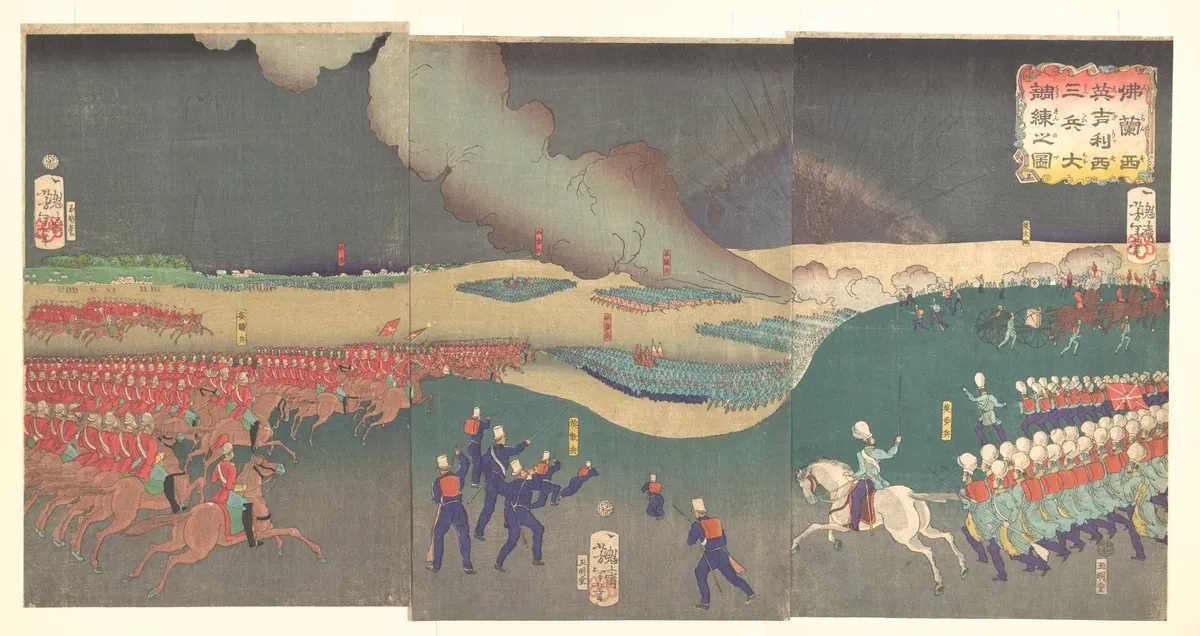
The Silent Drill
The air hung heavy with the scent of gunpowder and damp earth. Rows of soldiers stood before the rising sun, their uniforms a stark contrast against the pastel sky. Silence wrapped them like a shroud as they prepared for their morning maneuvers. French and English alike, their movements were precise, each step a whisper against the soft ground.
A crow cawed, breaking the stillness. The soldiers shifted slightly, their boots rustling the grass. From beneath the brim of his cap, a French officer's eyes flicked over the assembly, his gaze sharp as a blade. He barked a command, his voice a foreign note in the Japanese air, and the soldiers moved, their rifles gleaming in the early light.
Tsukioka Yoshitoshi watched from a distance, his hand steady as he captured the scene on paper. The clash of cultures, the blend of order and chaos—this was the world he sought to immortalise. The soldiers, unaware of his presence, continued their drill, each movement a dance of discipline and duty.
The sun climbed higher, casting long shadows across the field. Sweat trickled down the necks of the men, their breaths visible in the cool morning air. The drill continued, an echo of distant lands and foreign ambitions. Yoshitoshi's brush moved swiftly, capturing the essence of a moment poised on the edge of change.
Historical Echo
In August 1867, Japan stood at the cusp of transformation. Foreign powers, with their modern military tactics, had become a common sight. Tsukioka Yoshitoshi, a master of capturing the spirit of the times, depicted these soldiers with an eye for detail and a sense of the uncanny. The presence of French and English troops in Japan was a harbinger of the nation's inevitable march towards modernisation. In this print, the disciplined ranks and foreign uniforms are not merely subjects; they are symbols of a world in flux. The ukiyo-e serves as a testament to an era where the old and the new collided on the fields of a changing Japan.