

Three Categories in Formation
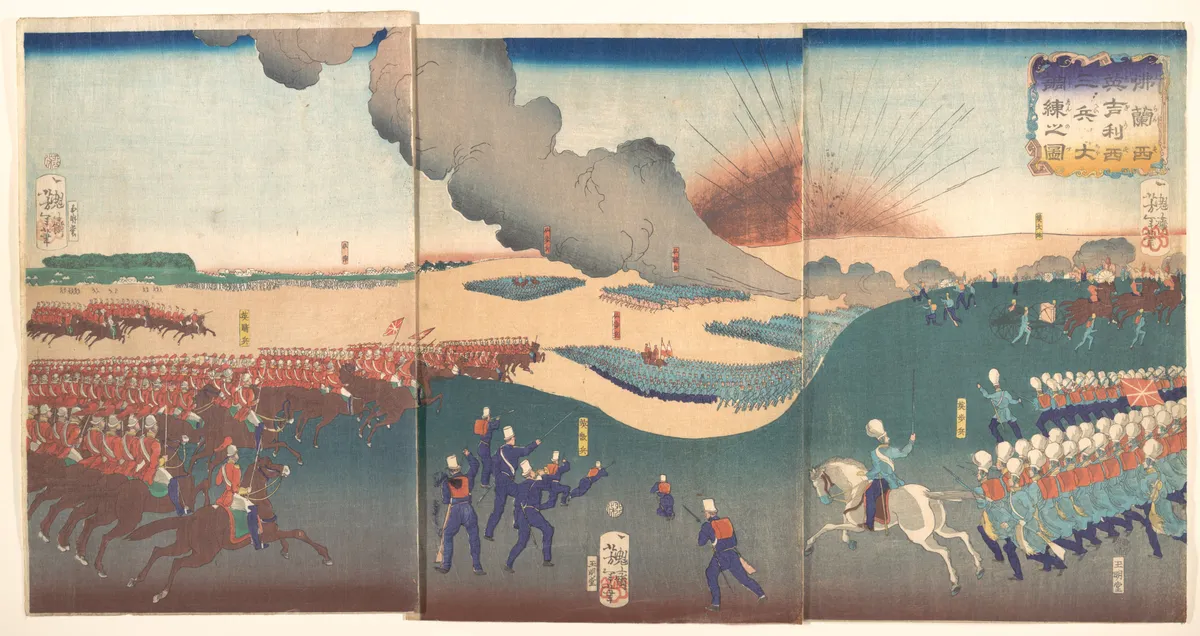
The air hangs heavy with anticipation. Rows of soldiers, their uniforms a strange blend of Western formality amidst the subtle hues of Edo, move with mechanical precision. The French and English flags ripple in the breeze, their colours stark against the muted sky. Boots scuff against the dirt, a rhythmic cadence broken only by the sharp calls of officers.
In the distance, a drumbeat echoes—a persistent reminder of order. The soldiers' eyes remain fixed ahead, their expressions unreadable masks of duty. Amidst the disciplined ranks, the scent of gunpowder lingers, a ghost of battles fought and victories claimed.
Light plays upon polished buttons and the gleaming barrels of rifles, casting fleeting reflections that dance like silent spectres. The morning mist clings to the earth, reluctant to release its grip as the soldiers prepare for maneuvers, each movement a testament to the disciplined force of foreign nations.
Historical Echo
August 1867. Japan stands on the precipice of transformation. The Bakumatsu period, a time of upheaval and change, sees Japan's shores welcoming foreign ships and ideas. Tsukioka Yoshitoshi captures this moment—a snapshot of Western influence upon traditional soil.
In his woodblock print, Yoshitoshi portrays the disciplined elegance of Western military tactics, a scene both foreign and fascinating to the Japanese public. The soldiers' meticulous formations, their foreign uniforms, and the fluttering flags encapsulate a world in flux, a country poised between past and future, tradition and modernity.