

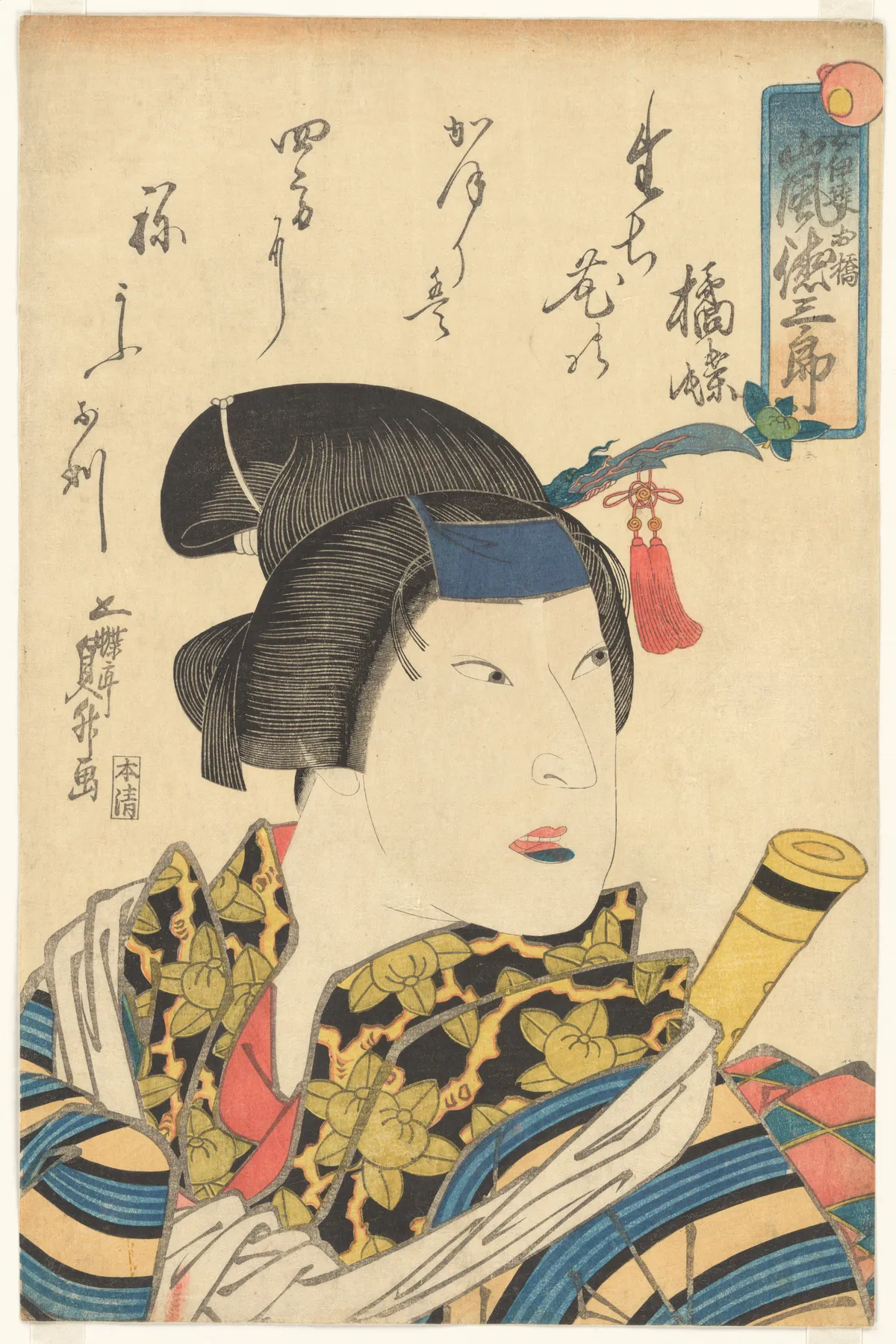
The Female Gallant
The night air was thick with anticipation. Paper lanterns flickered, casting wavering shadows on the wooden floorboards. A hush fell over the crowd as Arashi Tokusaburō stepped onto the stage, his presence commanding, his costume resplendent. He bore the guise of Ohashi, the female gallant, a figure both revered and feared. The silk of his robe rustled softly as he moved, a whisper against the silence.
His eyes, dark and brooding, scanned the audience, drawing them into the world of the play. The dim light caught the sheen of his makeup, accentuating the sharpness of his features. He was a master of transformation, embodying the strength and grace of Ohashi with each deliberate gesture. The air was heavy with incense, a fragrant fog that blurred the line between actor and character.
The audience watched, breath held, as the drama unfolded. Tokusaburō's voice, low and resonant, wove the tale of Ohashi's defiance and courage. Every word, every pause, was a thread in the fabric of the story. The stage became a realm of its own, alive with the echoes of past performances, the weight of tradition.
As the final scene drew near, the tension in the room was palpable. Tokusaburō, as Ohashi, stood poised, a figure of resolute strength. The lanterns flickered once more, their light casting long shadows that danced across the stage. In that moment, time seemed to stand still, the boundary between reality and illusion blurred.
The performance ended with a flourish, leaving the audience in a spellbound silence. Then, applause erupted, a cascade of sound that filled the theatre and spilled out into the night. Tokusaburō bowed, a slight, graceful movement, before retreating into the shadows. The ghost of Ohashi lingered in the air, a haunting presence that would linger long after the stage had emptied.
Historical Echo
In the Edo period, kabuki theatre was a world of vibrant spectacle and intricate storytelling. Arashi Tokusaburō was one of its luminaries, known for his ability to transcend gender roles, bringing to life the complex characters of the kabuki repertoire. The role of the female gallant, or onnagata, was one that required both strength and subtlety, a balance that Tokusaburō mastered with finesse.
Utagawa Sadamasu, who captured Tokusaburō's performance in this woodblock print, was a disciple of the Utagawa school. His work preserved the ephemeral beauty of the kabuki stage, a window into a world where art and life intertwined. This print, created in 1838, remains a testament to the enduring allure of kabuki and its power to captivate audiences across time.