

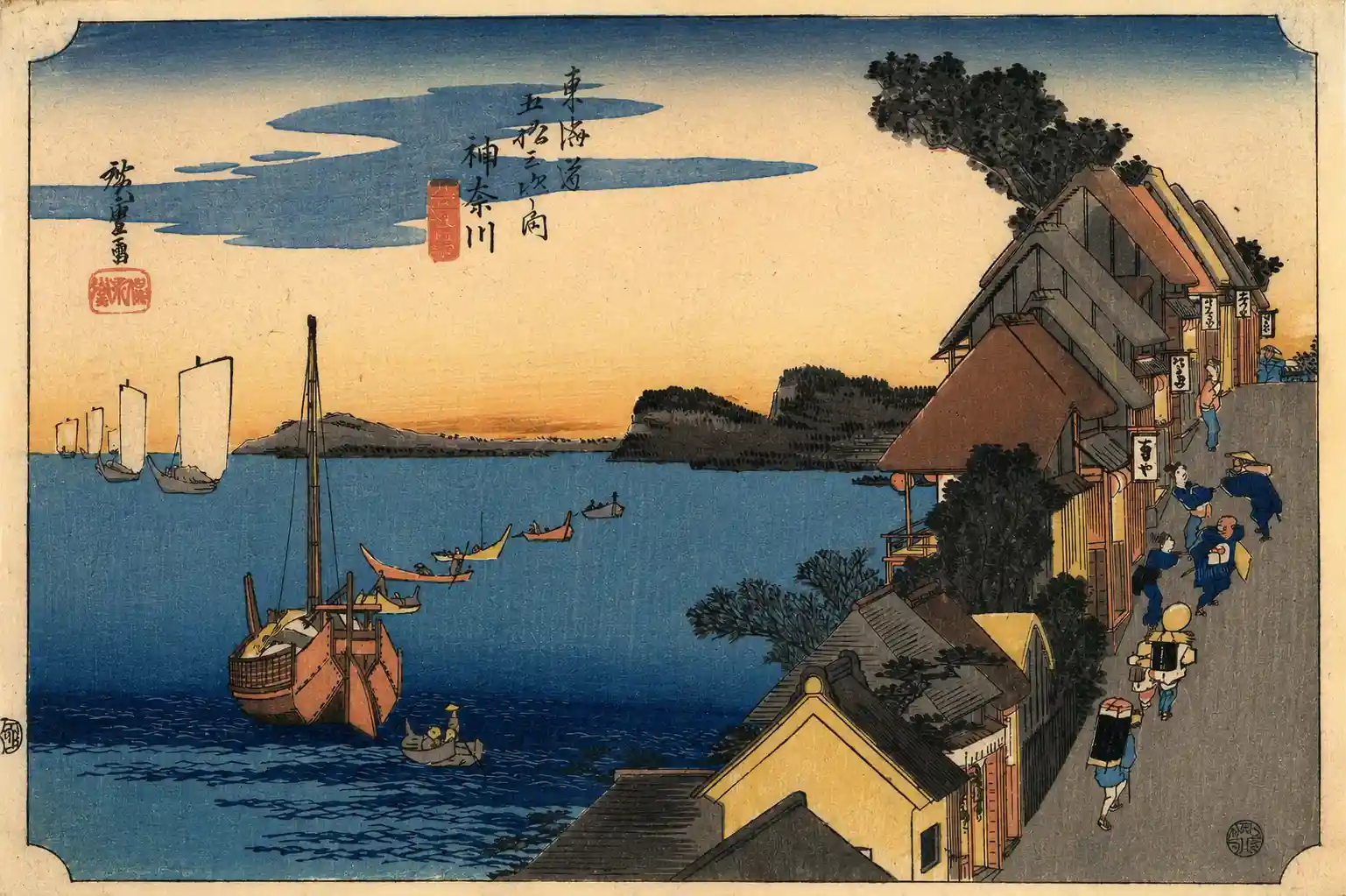
Kanagawa at Dusk
The tide ebbs away. A faint blue haze hangs over the waters of Kanagawa. Boats drift back to the harbour, burdened with salt and silence. The steep slope stretches ahead. Porters, heads bowed, scrape straw sandals against the dry path. Fish baskets weigh down their shoulders. Others hasten home, racing the dusk. Above, lanterns in inn windows flicker to life, casting warm amber glows against the chill.
A wind rises from the bay. It carries scents of sea brine and wet cedar through wooden eaves. Distant sails hang motionless, spectral, like relics from another realm. Silence blankets the harbour, broken only by the gentle nudge of boats against wooden piers.
This slope along the Tōkaidō pulses with footsteps. Samurai, merchants, actors, wanderers — all tread this path. Some journey towards Edo's ambitions, others retreat from its failures. Yet, as evening descends, a hush settles over travellers. The sea darkens. Kanagawa's nightfall is swift and unyielding.
A woman stands under the eaves, arms tucked into her sleeves, gazing towards the harbour. Soon, water will give way to shadow. Then, only scattered lights will remain. After that — only the wind.