

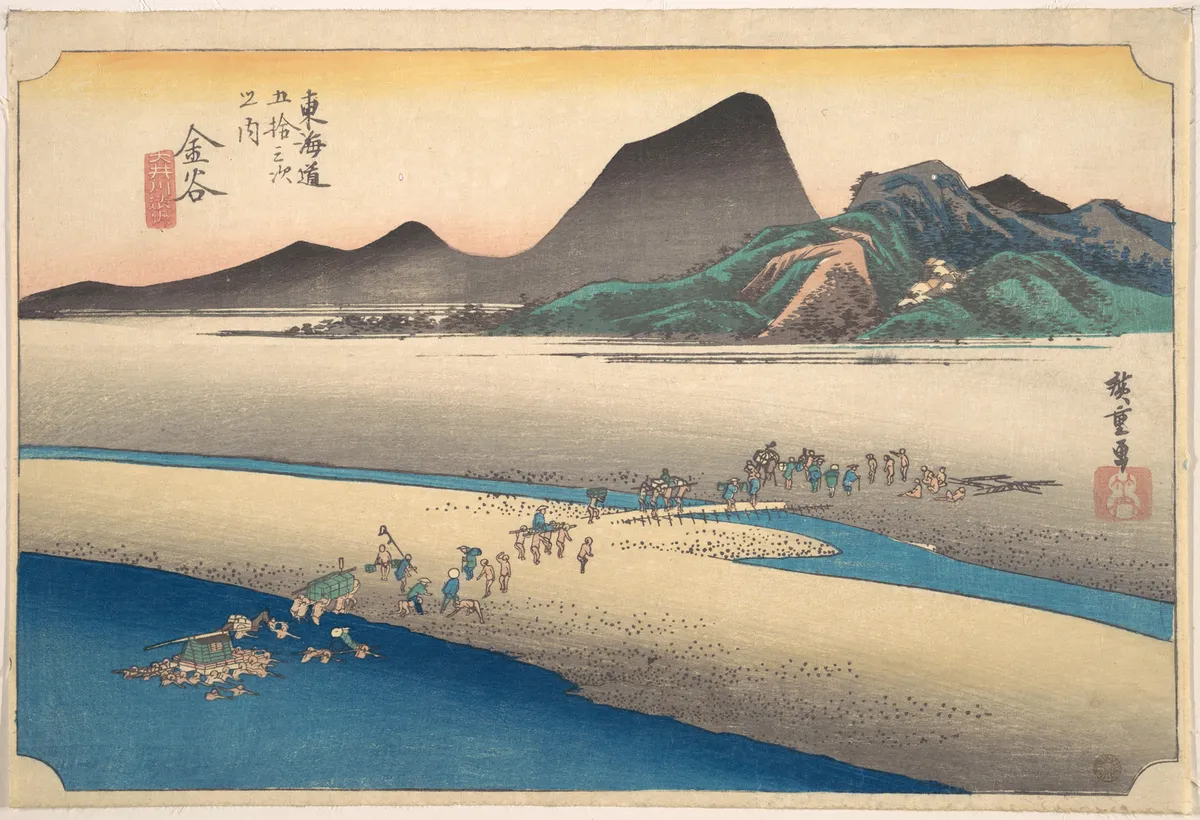
Crossing Oigawa
The river stretched wide under a heavy sky. Its waters flowed, grey and sluggish. Silence draped the scene, broken only by soft murmurs of distant travellers. They moved slowly, feet sinking into the damp earth, crossing the Oigawa at Kanaya.
A bridge arched, a slender spine against the horizon. Its wooden planks creaked with the weight of footsteps. Straw hats bobbed as farmers and merchants made their way. The air was thick, laden with the scent of wet earth and pine.
Mountains loomed, their silhouettes blurred by mist. The land felt ancient, worn by countless crossings, each leaving an echo in the air. Hiroshige's brush captured this moment, freezing it in time. The print was a window to a world both transient and eternal.
Historical Echo
In the Edo period, the Oigawa was notoriously difficult to cross. Travellers often faced delays, waiting for the waters to recede. Hiroshige's print captures this quiet struggle. The river was both a barrier and a lifeline, threading through Japan's landscape. Each crossing was a journey, a step into the unknown.