

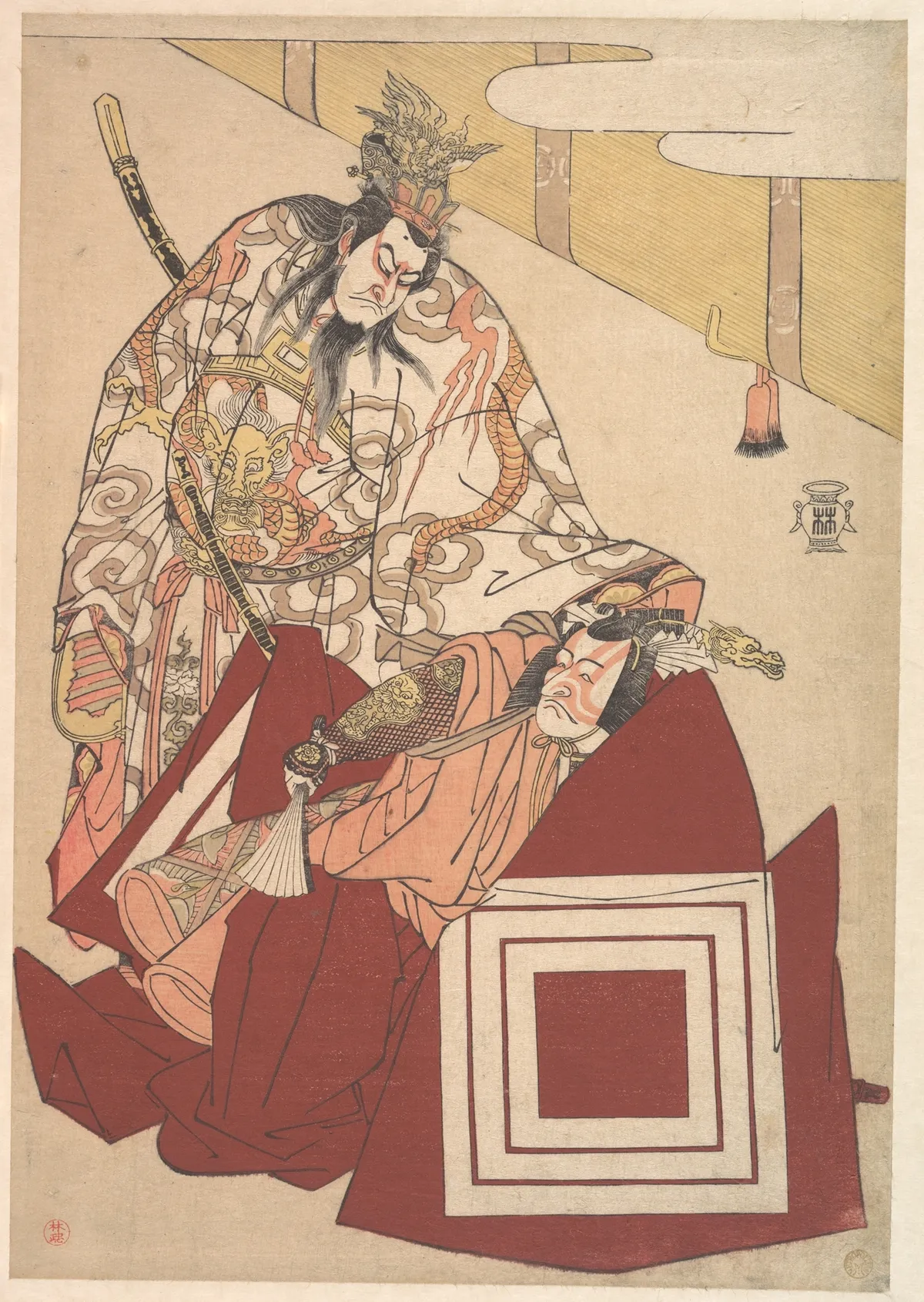
The Shibaraku Stance
The actor stands alone on the stage, his form a silhouette against the dim light. Ichikawa Danjuro V commands the space with a fierce presence. His eyes pierce through the painted mask, scanning the silent audience. Silence thickens the air, holding the crowd captive. In the muted glow of paper lanterns, shadows dance upon his elaborate costume, each fold meticulously crafted for this moment. The robe, heavy with embroidered dragons, sways gently with his every breath.
The theatre is hushed, save for the soft rustle of silk and the distant murmur of anticipation. Faces in the audience are pale under the flickering candlelight, eyes wide, awaiting the actor’s next move. The scent of incense lingers, mingling with the earthy aroma of wooden beams and tatami mats.
Danjuro's hand rises, cutting through the air with deliberate grace. A powerful cry erupts from his lips, the iconic “Shibaraku!” echoing through the rafters, shaking the very foundation of the theatre. It is a call that reverberates not just in the ears but in the hearts of those present, a reminder of the ancient tales that bind them all.
He holds the pose, a living statue, embodying the spirit of the warrior. The tension is palpable, a string pulled taut, vibrating with the energy of the performance. Every eye is on him, every breath synchronized with his. The moment stretches, timeless, as if the world has paused to bear witness to this singular act of art and tradition.
Historical Echo
In the Edo period, the kabuki stage was a realm of transformation, where actors like Ichikawa Danjuro V became legends. Shibaraku, a dramatic pause, was more than a performance; it was a cultural phenomenon. Katsukawa Shunkō captured this essence in his woodblock print, immortalizing a moment of theatrical triumph. The print reflects the boldness of kabuki, where art and life blurred, and the audience was as much a part of the performance as the actor himself.