

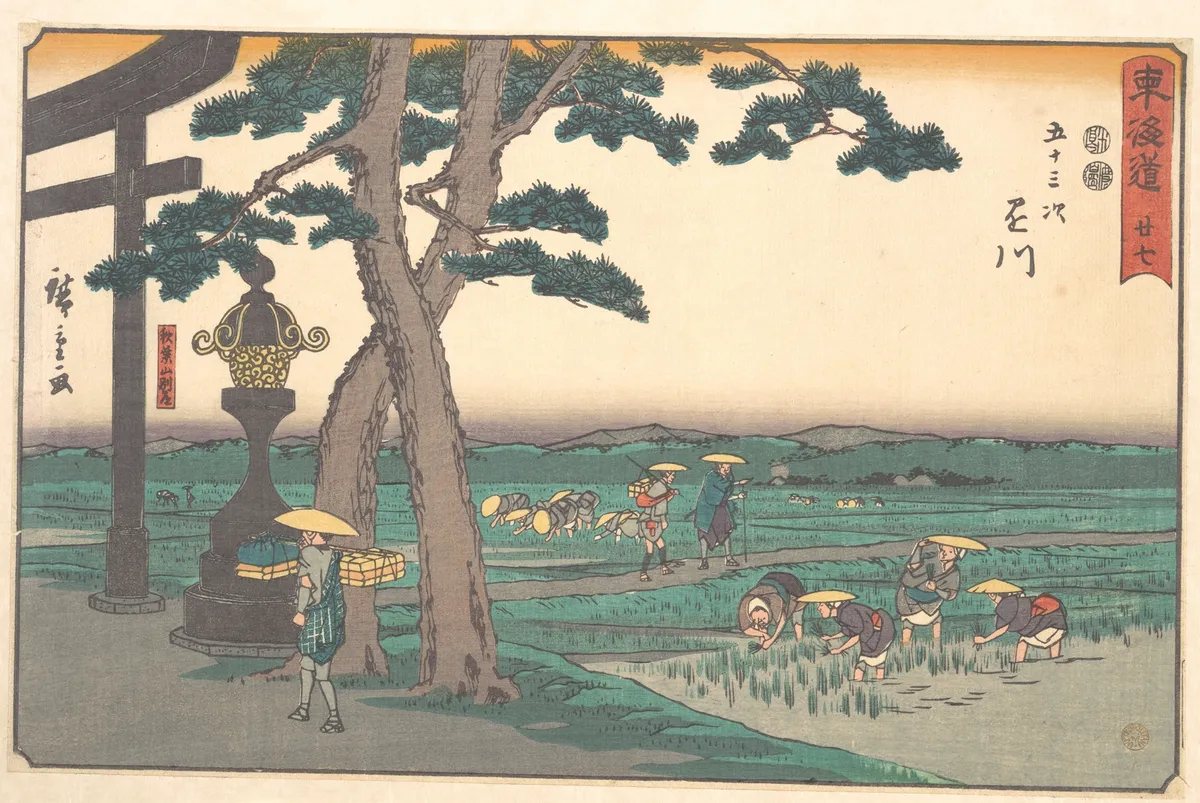
Crossing Kakegawa
A bridge arches over the gentle river. The wood, worn by countless footsteps, whispers stories of distant lands. Below, water murmurs, carrying reflections of clouds and sky. The air is thick with the scent of pine and distant rain.
Travellers move deliberately, their sandals pressing into the damp earth. A merchant with a heavy pack pauses, adjusting his load. His eyes trace the flowing river, lost in thought. Beside him, a child skips, splashing in shallow puddles.
In the distance, mountains rise, shrouded in mist. Their silent presence looms over the scene, ancient and unchanging. The horizon blurs where land meets sky, a seamless blend of greys and greens.
A sudden breeze stirs the leaves. The world holds its breath as a bird takes flight, its wings cutting through the still air. The moment stretches, fragile and fleeting.
As the day wanes, shadows creep across the bridge. Lanterns flicker to life, casting a warm glow on the travellers. The journey continues, a silent procession against the encroaching night.
Historical Echo
Kakegawa, a serene landscape captured by Utagawa Hiroshige, reflects the Edo period's reverence for nature's tranquillity. This print belongs to Hiroshige's celebrated series, "The Fifty-three Stations of the Tōkaidō," depicting the journey along the Tōkaidō road. Each station offers a glimpse of life and travel in 19th-century Japan. These prints were cherished by those who longed to wander or remember the paths once travelled.