

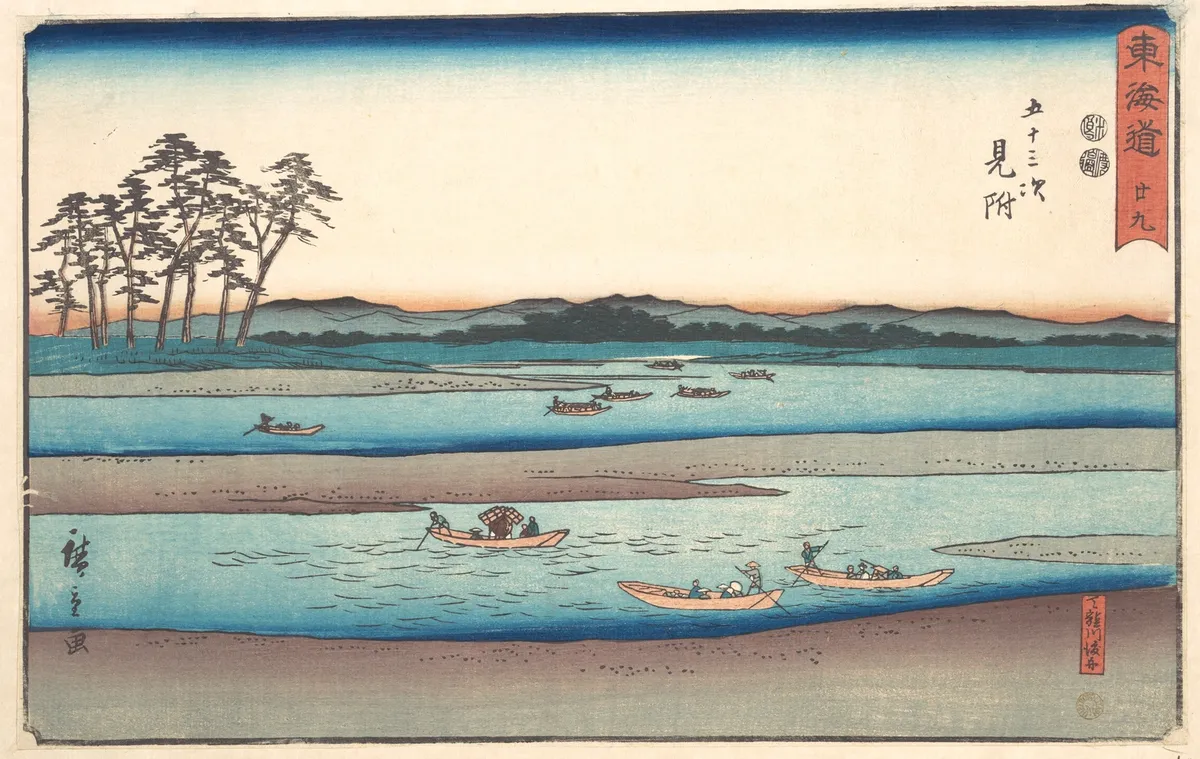
Crossing at Mitsuke
A grey dawn light drapes over the landscape. The wooden bridge stretches across the river, its planks slick with morning dew. Travellers, small against the vast, open sky, move with purpose. Their footsteps are muffled by the mist that lingers, thick and silent.
A lone fisherman casts his line from the riverbank, the water a mirror of pale light. The air is cool, carrying the scent of wet earth and distant rain. In the distance, hazy silhouettes of trees mark the horizon, their leaves stirring gently in the breeze.
The river flows steadily, unhurried, a constant murmur beneath the bridge. It whispers stories of journeys and farewells, of promises and forgotten dreams. The travellers continue their crossing, each step a quiet echo on the wooden boards.
Somewhere, a bird calls, its song a solitary note in the stillness. The sky lightens, shadows retreating as morning unfolds. The bridge, the river, the path ahead—all bathed in the soft, muted hues of a new day.
Historical Echo
In the Edo period, bridges were lifelines, binding towns and travellers. Utagawa Hiroshige captured this in "Mitsuke," a scene alive with quiet movement. His work reflects a world where nature and man coexist, where every crossing holds a story. The landscape, serene yet stirring, invites reflection and passage.