

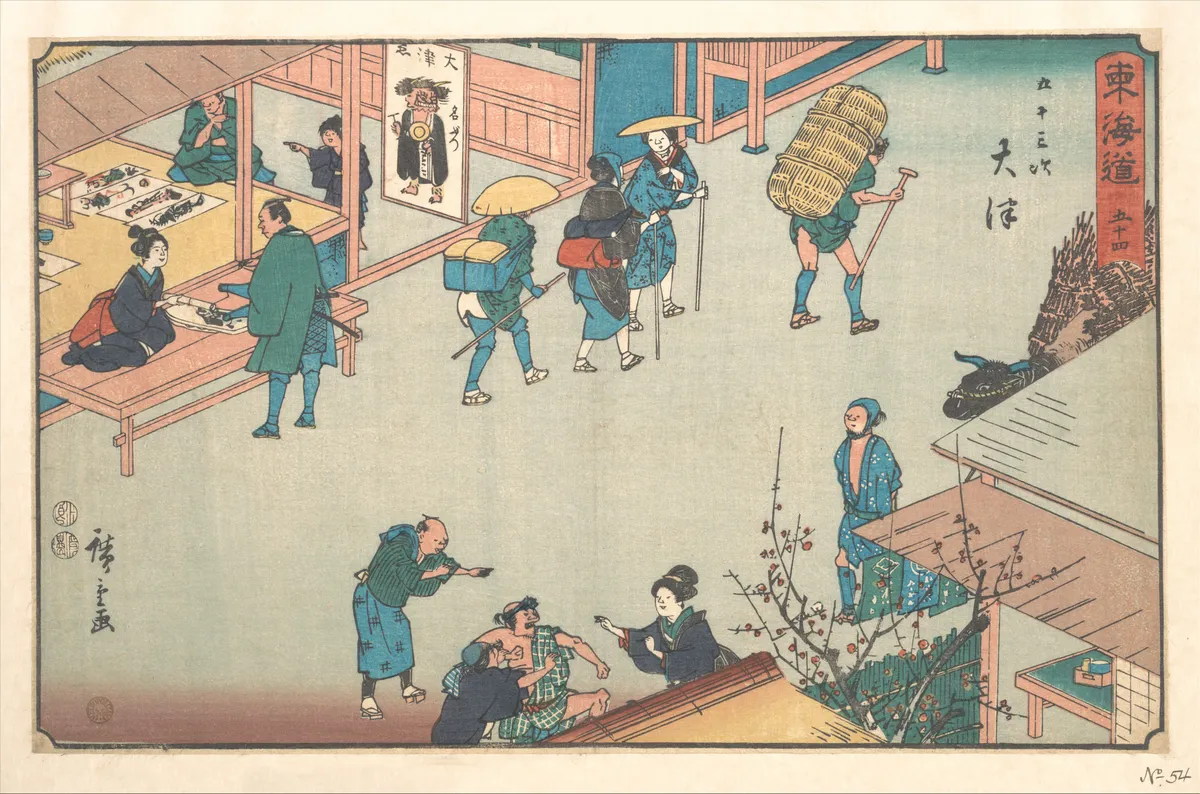
A Quiet Passage through Ōtsu
The rain whispered against the wooden eaves, a gentle murmur in the early dawn. Travellers moved slowly along the Tōkaidō Road, their footsteps a soft rustle on the damp earth. Lanterns flickered in the grey light, casting long shadows that danced across the path.
A vendor, hunched over his cart, adjusted the cloth covering his wares. The air smelled of wet pine and distant fires. A woman, her kimono heavy with moisture, paused beneath the eaves of a teahouse, her eyes on the distant hills, obscured by mist.
Voices murmured, low and indistinct, blending with the patter of rain. The road stretched out, a winding ribbon through the town of Ōtsu, where the promise of travel intertwined with the quiet persistence of daily life.
A lone figure, a pilgrim perhaps, moved with purpose, his straw hat dripping, his staff tapping a steady rhythm. The scene unfolded in a muted palette, a tapestry of sound and silence, where each traveller carried their own stories, hidden beneath layers of cloth and time.
The rain continued, unending, as the day crept slowly forward.
Historical Echo
The Tōkaidō Road, a vital artery of Edo Japan, connected Kyoto to Edo (modern Tokyo). Ōtsu, the last station before Kyoto, bustled with travellers and merchants. The journey was long and arduous, yet each station offered a brief respite. In this scene, captured between 1847 and 1852, the timeless rhythm of travel echoes through the rain-soaked streets, a fleeting moment preserved in wood and ink.