

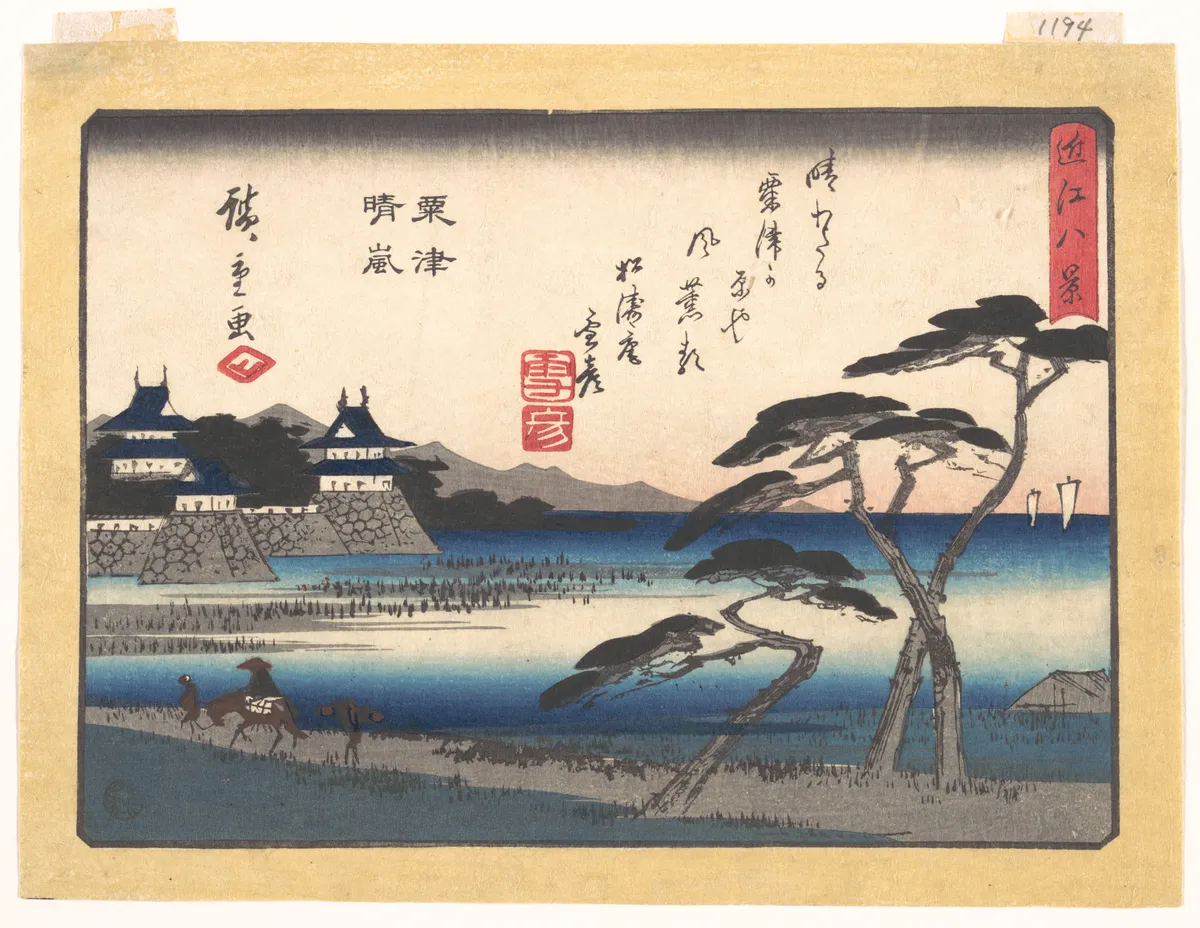
Clearing Weather at Awazu
The mist lingers over Awazu. Silent, like a breath held too long. Mountains rise, shrouded in a gentle haze, their outlines softened by the morning's embrace. A village nestles beneath, its thatched roofs still wet from the night rain. The air is cool, carrying whispers of damp earth and pine needles.
The lake mirrors the sky, a silken canvas stretched across the horizon. Light breaks through the clouds, touching the water with a tender hand. A fisherman, barely a silhouette, casts his net into the ethereal glow. He moves with practiced grace, his presence a quiet echo in this tranquil scene.
In the distance, a lone figure walks along the shore. Each step deliberate, a cadence of solitude. The path is soft underfoot, marked by the night's passing storm. He pauses, glancing upwards, as if the sky might offer some forgotten secret.
The world inhales. A moment suspended in time, where the past and present breathe as one. The air is heavy with the scent of awakening, the promise of a day yet to unfold.
Historical Echo
Hiroshige's "Clearing Weather at Awazu" is a meditation on transience. Created around 1834, it belongs to his series "Eight Views of Ōmi". Each print captures the subtle dance of nature and time. Here, the landscape of Awazu becomes a quiet dialogue between land and sky. It invites the viewer to pause, to listen to the echoes of the past that linger in the folds of mountains and the ripples of water.