

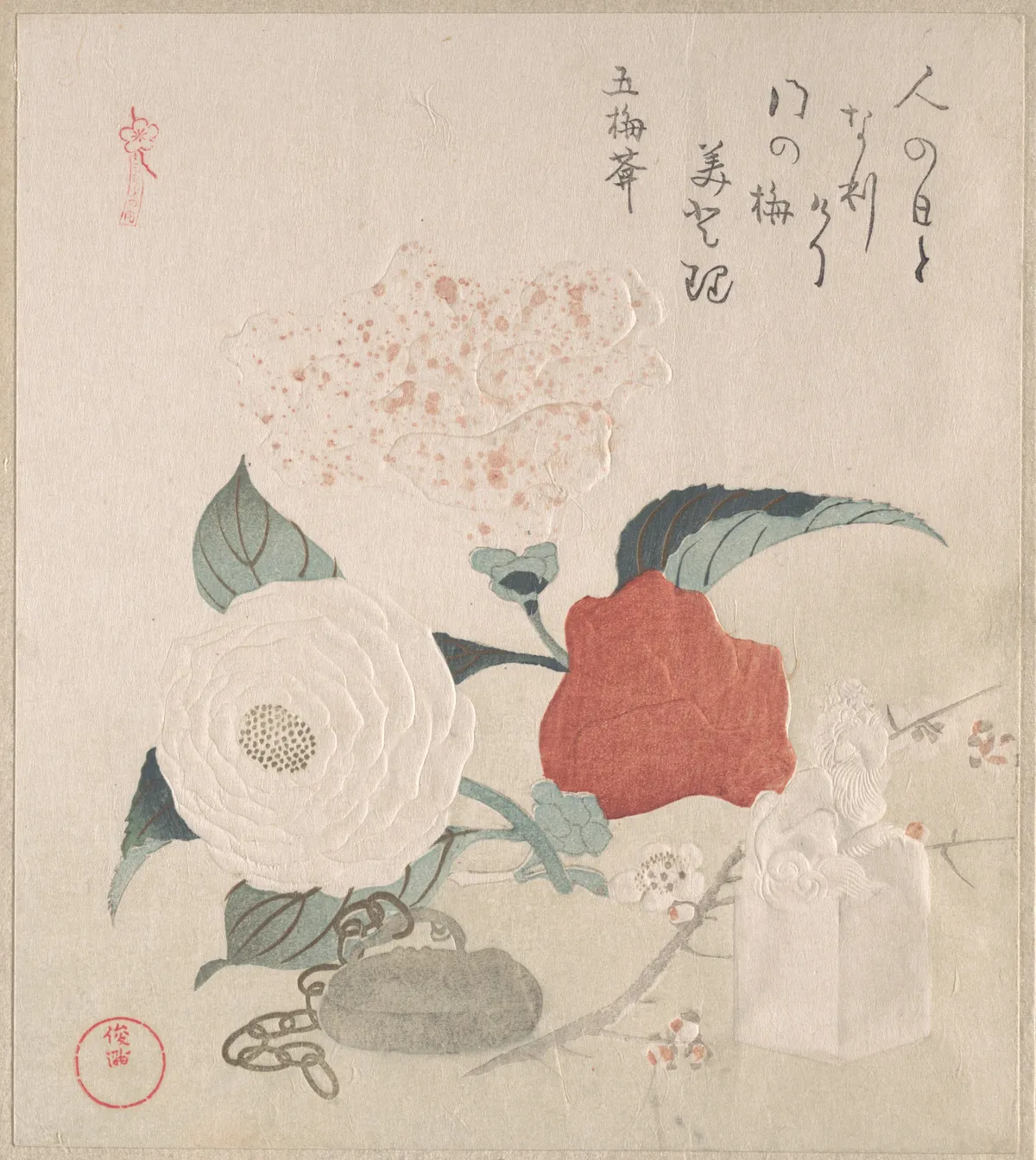
Camellia Flowers, a Netsuke and a Seal
The air was still, heavy with the scent of camellia. Their petals lay scattered like whispers upon the wooden table. A netsuke carved in ivory rested beside them, its smooth surface catching the dim light. Near it, a seal, worn with time, lay silent and solemn. Shadows collected in the crevices of the room, quiet but watchful.
It was a moment suspended in a breath. The camellias, vivid against the grain of wood, seemed to hold secrets in their folds. The netsuke, a guardian of tales untold, watched over them. The seal, a mark of stories once sealed and forgotten, stood as witness.
The room was a sanctuary of silence. Outside, the winds sighed through pines, a distant murmur. Inside, the past lingered in the air, as tangible as the scent of the flowers, as real as the touch of ivory and stone. Each object a fragment of a life once lived, a narrative etched in the quietude of the scene.
Historical Echo
Kubo Shunman, an artist of the Edo period, found beauty in simplicity. His work captured the fleeting moments, where nature and objects converged in harmony. The camellia, a symbol of beauty and love, combined with the netsuke and seal, reflected a culture that cherished the ephemeral. The print, a delicate balance of form and shadow, speaks of a world where every detail mattered. Shunman's artistry lay in his ability to make the mundane resonate with quiet significance.