

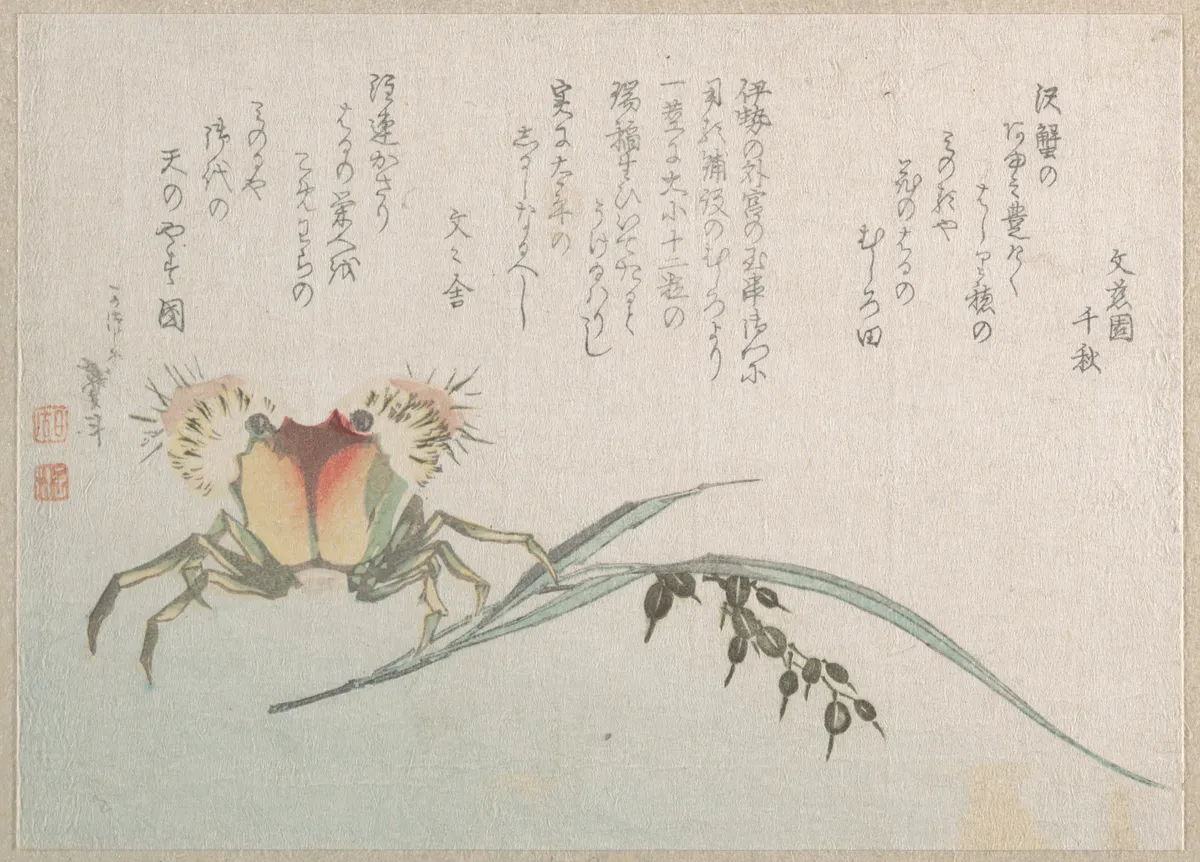
Crab and Rice Plant
The crab moved slowly along the muddy bank. Its legs clicked softly against pebbles. Dark clouds loomed overhead, whispering rain. The air was thick with the scent of wet earth. A lone rice plant stood nearby, its stalks bending under the weight of impending storm. Each leaf trembled as the wind passed through, a gentle rustle in the silence.
The crab paused, sensing the vibrations through the ground. It raised its claws, poised to defend against any unseen threat. A droplet of water fell, darkening the mud where it landed. The rice plant swayed, its roots holding firm in the saturated soil.
Hokusai captured this moment, the tension between the elements. The simplicity and rawness of nature, unadorned. The crab, a solitary figure amidst a world poised to burst into life with the coming rain.
Historical Echo
Katsushika Hokusai's work reflects a deep observation of nature. Born in 1760, he witnessed the transforming landscapes of Edo Japan. Hokusai's prints often depicted the simple beauty of the natural world. In "Crab and Rice Plant," he distills life into a single, serene moment. The 19th century brought shifts in art and society, yet Hokusai's focus remained on the enduring presence of nature. His work continues to resonate, a quiet echo of an era long past.