

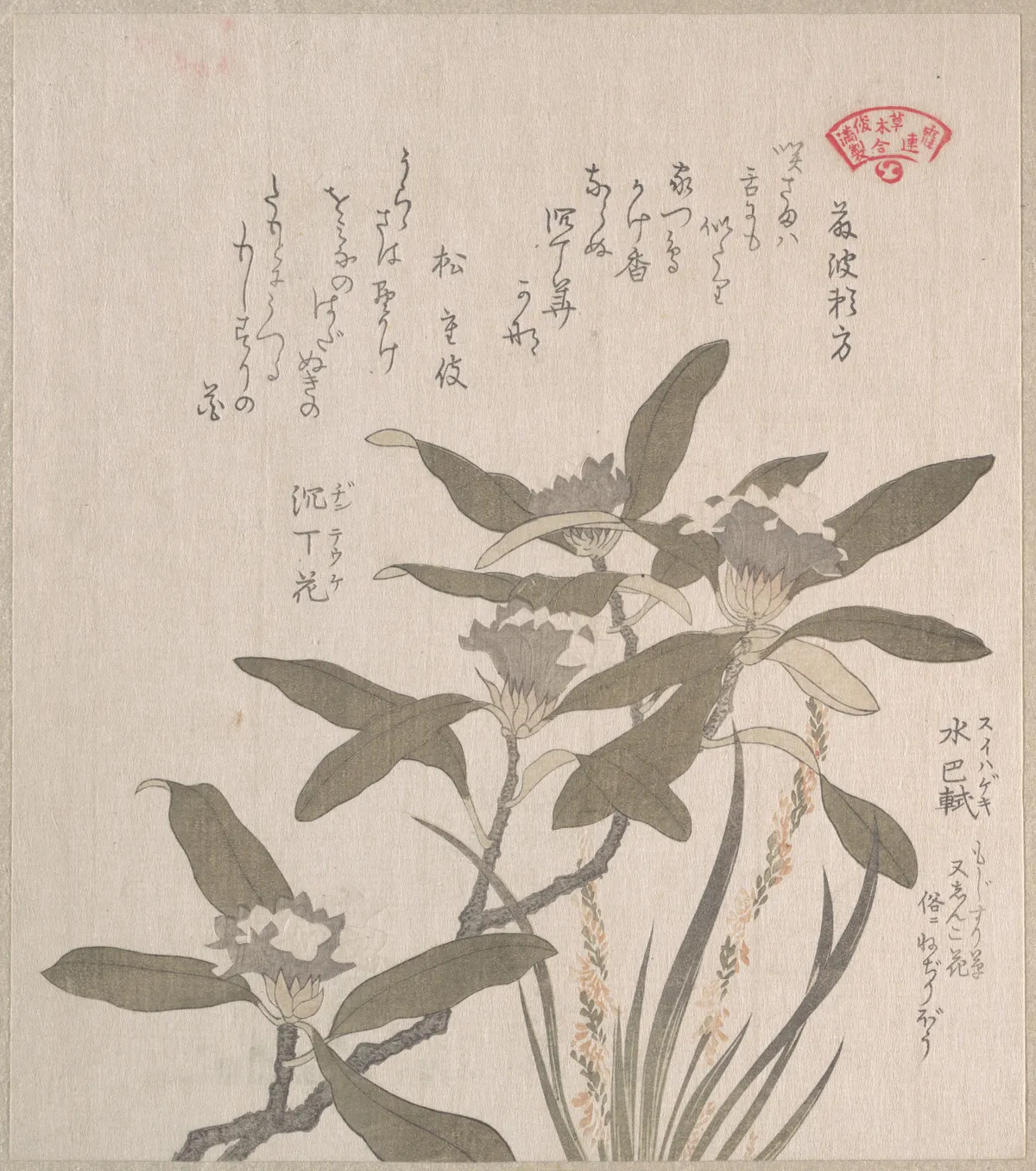
Daphne's Fragrance
The air was heavy with the scent of daphne. Its fragrance lingered in the folds of silk robes, mingling with the dampness of the earth. Shunman’s hand moved deftly, capturing the delicate interplay of petals and leaves. The print slowly emerged, each stroke of ink breathing life into the paper.
The Mojisuri-so plant stood silent, its leaves whispering secrets of the past. They held the memory of rain and the touch of wind. The room was quiet, save for the soft rustle of paper and the muted clink of tools. Shadows danced across the walls, thrown by the flickering light of a solitary lantern.
In this dim space, time seemed to stretch and fold, like the patterns on the kimono draped over a nearby stool. There was a melancholy in the air, a haunting echo of seasons long gone. The daphne’s scent wrapped around Shunman, an unseen companion in the solitude of his craft.
Historical Echo
Kubo Shunman was known for his sensitive depictions of nature. In the 19th century, his work captured the fleeting beauty of plants like the daphne and Mojisuri-so. The daphne, cherished for its intoxicating fragrance, was a symbol of ephemeral beauty. Shunman’s prints were a window into a world where nature and art intertwined, whispering stories of a bygone era.