

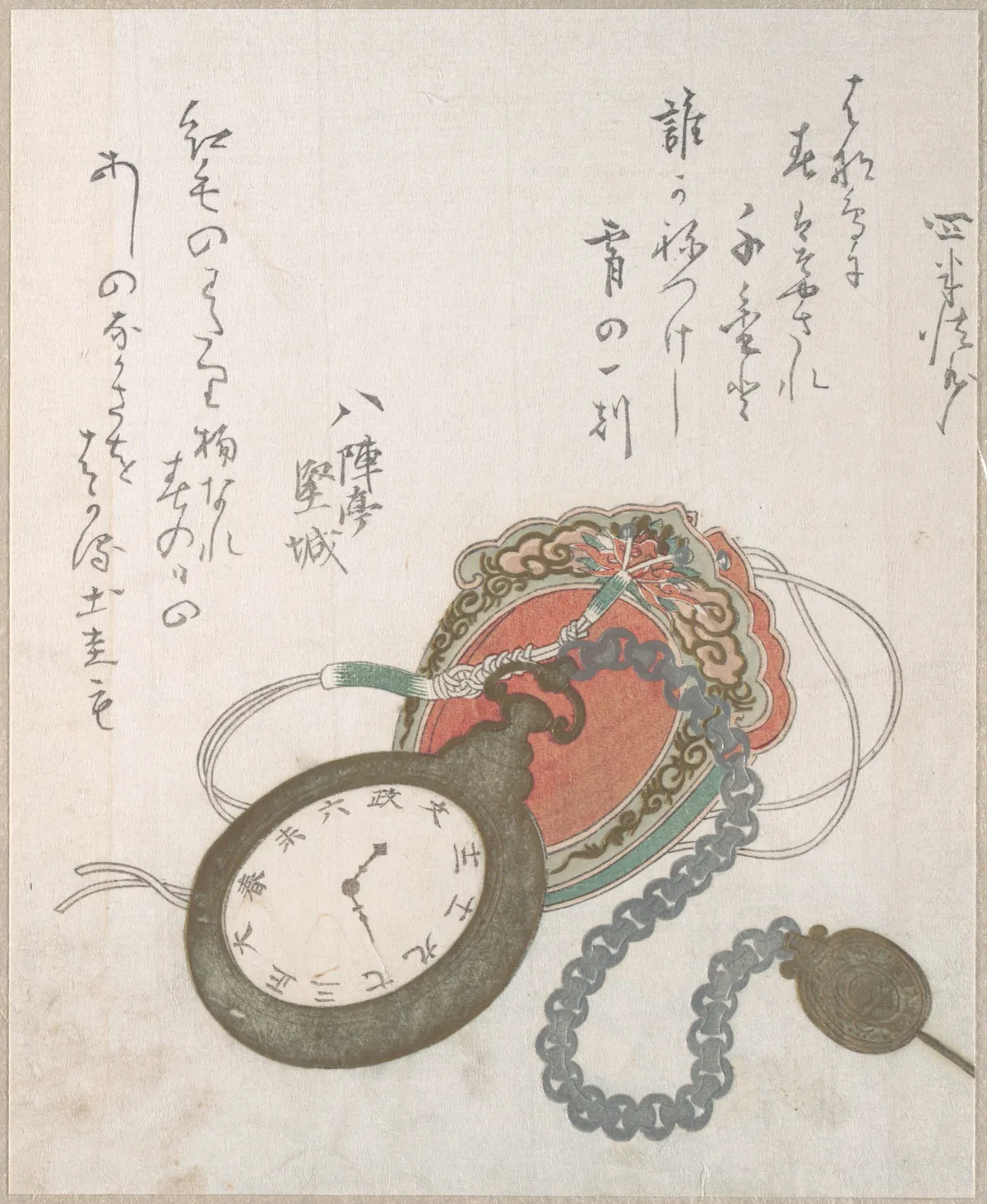
Western Pocket Watch
Rain whispered against the paper screens. A delicate sound, like silk brushing against silk. Inside, the air was still. Hiroshige sat cross-legged, surrounded by the scent of wet earth and ink. His brush moved with a deliberate grace, capturing the watch's foreign curves and intricate gears.
This was not a mere object. It ticked with a life of its own. Imported from lands beyond the sea, it carried whispers of distant places. It spoke a language of precision and metal, foreign to the natural rhythms of Edo. Yet here it was, nestled into the heart of the Spring Rain Collection.
A candle flickered beside him, casting long shadows on the tatami. The watch's face glinted in the dim light, its hands moving silently, methodically. Each tick a reminder of moments slipping away, of rain falling endlessly on the city outside.
Hiroshige paused, listening. The world outside was a blur of grey and wetness. Inside, the watch held its own time. A time sealed within glass and metal, untouched by the rain's gentle insistence.
He returned to his work, feeling the weight of the watch's silent song. Each brushstroke a tribute to this strange harmony. East meeting West. Time suspended in the hush of a rainy afternoon.
Historical Echo
In 1823, Edo was a city in transition. Western influences began to seep into its fabric. The pocket watch symbolised this shift. A marvel of European craftsmanship, it fascinated and bewildered. Hiroshige's work captured this dichotomy. The ukiyo-e, a traditional form, now cradled a foreign object. It was a moment of cultural fusion, preserved in the quiet of a woodblock print. The rain continued to fall, unchanging, as time moved forward.