

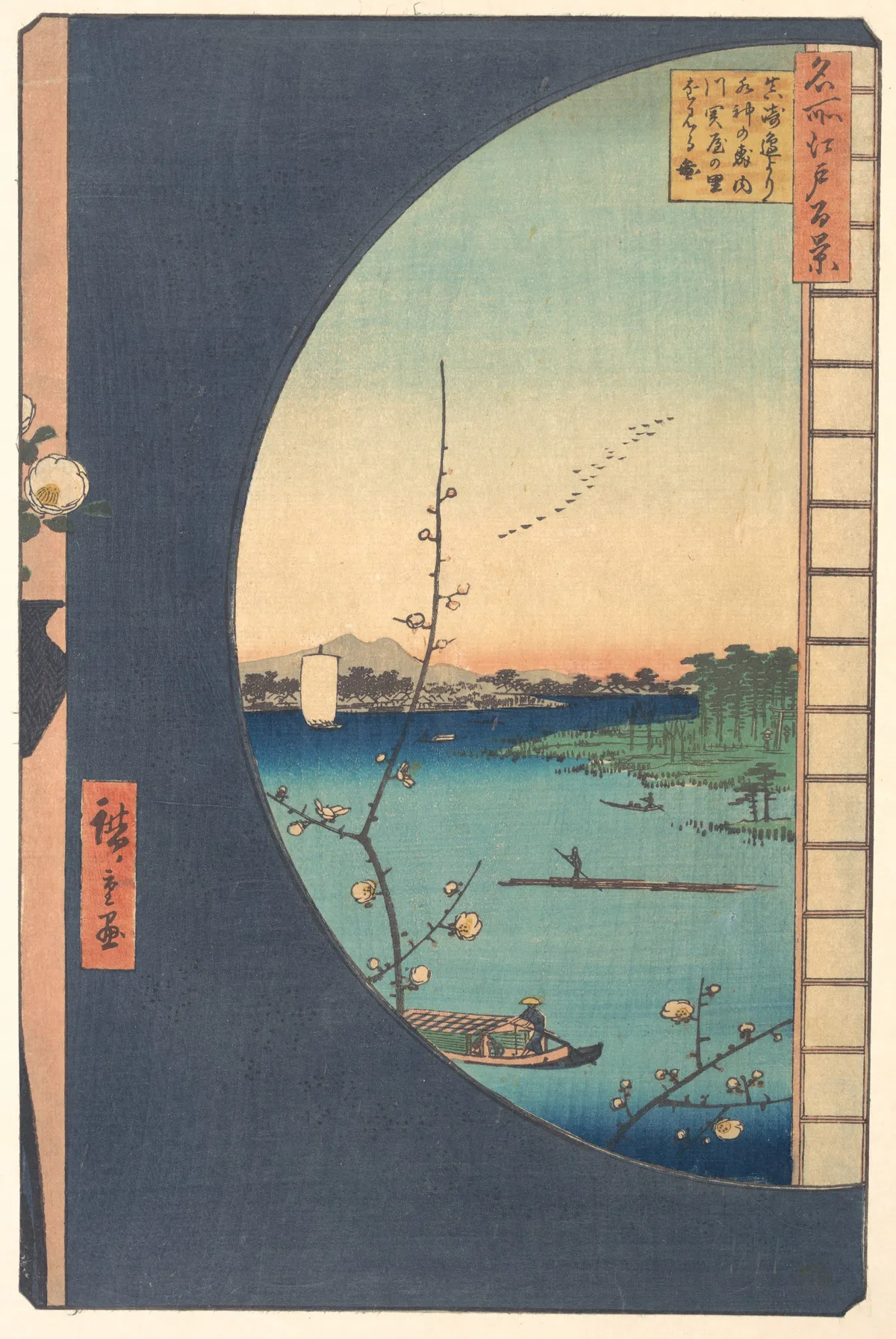
Into the Quiet of Suijin no Mori
Mist clings to the Uchikawa's surface. The river is a mirror, reflecting the muted sky. A lone boat drifts silently, its oar slicing through the stillness. The air is heavy with the scent of damp earth and pine. Trees stand as silent sentinels, their branches whispering secrets to the wind. Shadows stretch long across the water, mingling with the reflections. Time slows in this secluded grove, far from the clamor of the city. Each ripple on the water tells a story of the past, echoing through the quiet. A heron lifts into flight, breaking the silence with the rustle of wings. Then, stillness returns, as if the world holds its breath. Here, in Suijin no Mori, the forest listens, and the river remembers.
Historical Echo
Hiroshige captured this scene in 1857, a world on the brink of change. The Edo period's end lingered just beyond the horizon. Yet, in this moment, nature's timelessness prevailed. The artist's eye found beauty in simplicity, in the meeting of water and land. His prints, cherished by many, offer a window into a Japan where nature's voice was clear and strong. In the echoes of Suijin no Mori, one hears the whispers of a bygone era, preserved in ink and paper.