

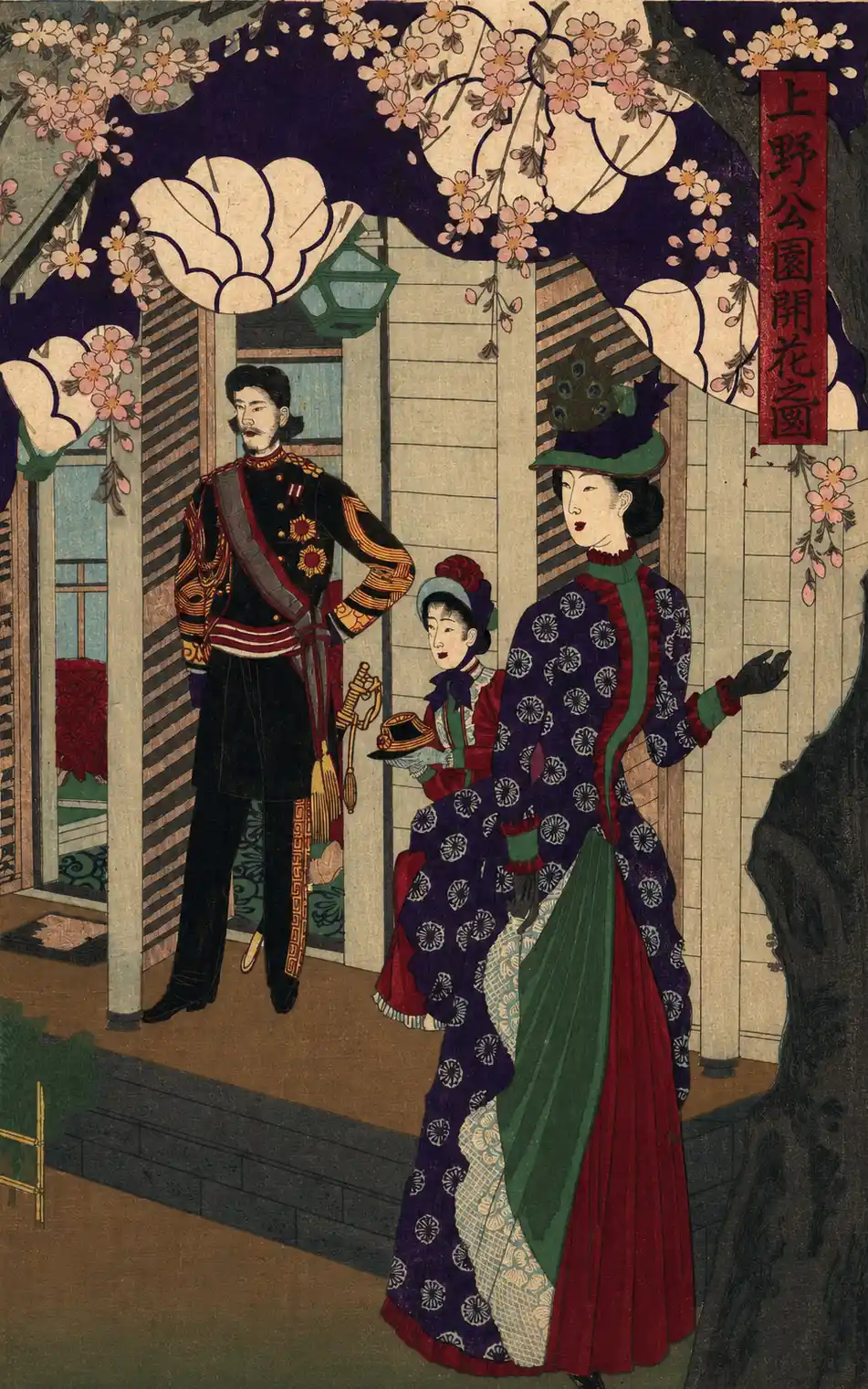
Blossoms at Dusk
The air is thick with anticipation, as if the very earth holds its breath. Cherry blossoms dangle above, their petals a soft whisper against the darkening sky. A woman stands silent, her back to the wooden house. Her indigo coat absorbs the dim light, wrapping her like the night itself. Just beneath, a flash of red—vivid and dangerous—peeks from her sleeve.
Behind her, a man waits in military garb. The gold of his uniform catches the flicker of an oil lamp's glow. It's not the garb of a samurai. No swords hang at his side. Only the weight of a different time.
Inside, a young girl carries a tray with careful steps. The clink of porcelain echoes her quiet fear. She knows nothing of politics, only that the men in boots seem more ominous than swords. Above, the cherry branches bend with the weight of bloom, their pale petals like fleeting snow against the deep violet sky.
The woman lifts a hand, fingers barely moving. Is it a farewell? Or merely a hesitation? The air carries the scent of damp wood and fresh paint, mingling with the memory of old paper walls. Two eras stitched together, uneasy and raw.
In the distance, wheels clatter—a sound of civilisation, of progress without horse or blade. The blossoms fall steadily, a gentle rain of memory, as if trying to hold onto the last breath of Edo's spring.
Historical Echo
Years later, these images would become known as Yokohama-e. But to those who first saw them, they were simply the world shifting beneath their feet. Western dresses, oil lamps, medals—all felt like intruders in a waking dream. The prints captured more than change. They held the quiet dread of a country on the brink of losing its shadowed past.
Civilisation, it was said, first erased the darkness. Once oil lamps lit the night, there was nowhere left for Edo's ghosts to hide.