

The Silent Stage
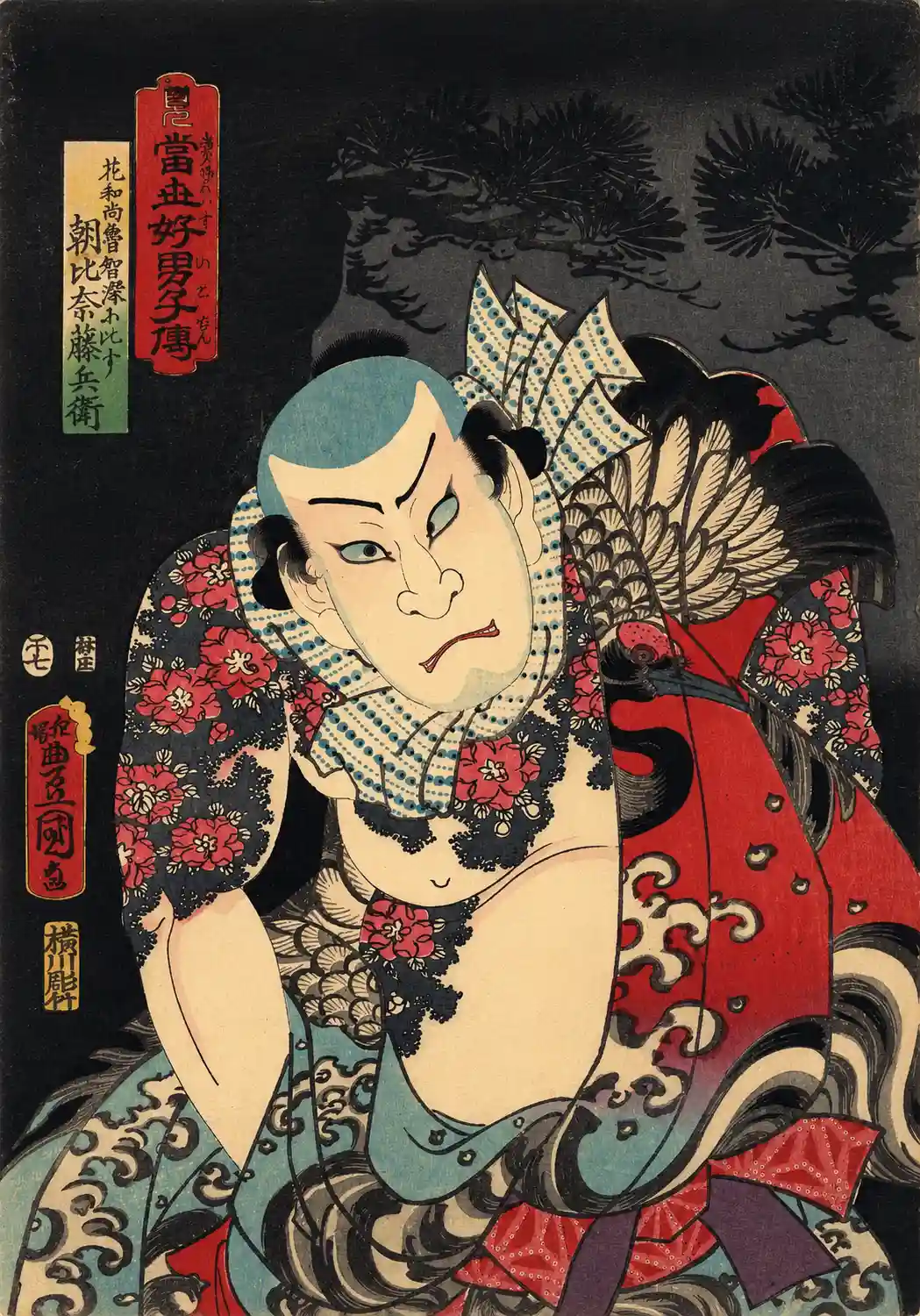
The stage is hushed, save for the whisper of silk. Nakamura Fukusuke I stands as Asahina Tōbei, his posture defiant against the weight of the night. His eyes, narrow and alert, scan the unseen, as if sensing danger beyond the paper-thin walls. He is Lu Zhishen, the tattooed priest, a figure of both reverence and fear.
Heavy robes drape over him, their fabric alive with the tumult of waves. Each fold tells of storms and secrets sewn into the threads. His face, painted in stark white, glows eerily under the dim light, a mask concealing more than it reveals. Feathered crests on his shoulders mimic birds in flight, captured mid-escape.
The audience is silent, breaths held as if collectively waiting for a signal. The actor embodies his role so thoroughly, one might believe he stands not on a stage but upon a precipice. Edo's citizens are drawn to this moment, the fine edge where persona and person blur, where heroism meets vulnerability.
A clapper strikes, a sharp punctuation against the silence. The actor remains unyielding, a ghost anchored to the boards beneath him. He is both man and myth, a living woodcut against the backdrop of an unfolding night.
Historical Echo
Nakamura Fukusuke I was renowned for his kabuki performances during the late Edo period. His portrayal of Asahina Tōbei, likened to the legendary Lu Zhishen from the Chinese classic "Water Margin," captured the imagination of Edo's theatre-goers. Utagawa Kunisada immortalised such moments in his woodblock prints, offering a glimpse into the vibrant world of kabuki where actors became living legends. These prints, fragile yet enduring, remind us of a time when the line between art and life was exquisitely blurred.