

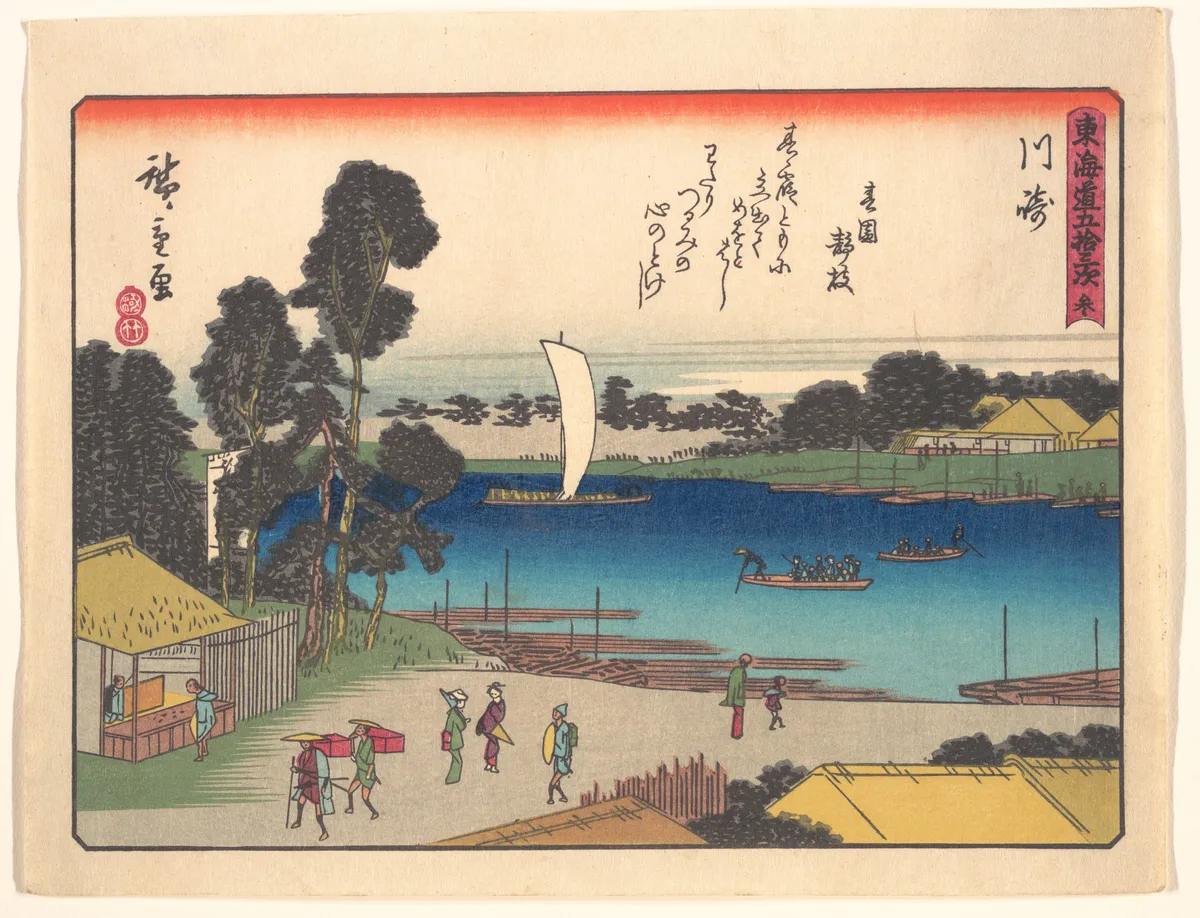
Kawasaki Station on the Tokaido
The rain fell in thin, persistent lines, merging earth and sky into a muted grey. Beneath the wide eaves of a teahouse, travellers huddled, their straw hats dripping. The Tokaido road stretched ahead, a weary ribbon of mud. A lone figure, cloaked and hooded, trudged past, his wooden sandals slapping against the sodden ground. In the distance, the ferry rocked gently on the swollen river, its silhouette blurred by the downpour. A lantern flickered, casting a warm glow on the wet wood, defying the chill of the afternoon. The scent of damp earth mixed with the faint aroma of tea leaves, rising from the steaming cups held by the waiting guests. Silence settled over the scene, punctuated only by the soft patter of rain and the occasional creak of the ferry's ropes. This was Kawasaki, a brief pause on the long journey along the Tokaido.
Historical Echo
Kawasaki was a vital post town on the Tokaido, a bustling artery connecting Edo and Kyoto. Hiroshige captured its essence even as modernity whispered at its fringes. The early 20th century saw change, but the spirit of the road lingered. The print, a nostalgic echo, reminds us of the weary feet and hopeful faces that once travelled its length.