

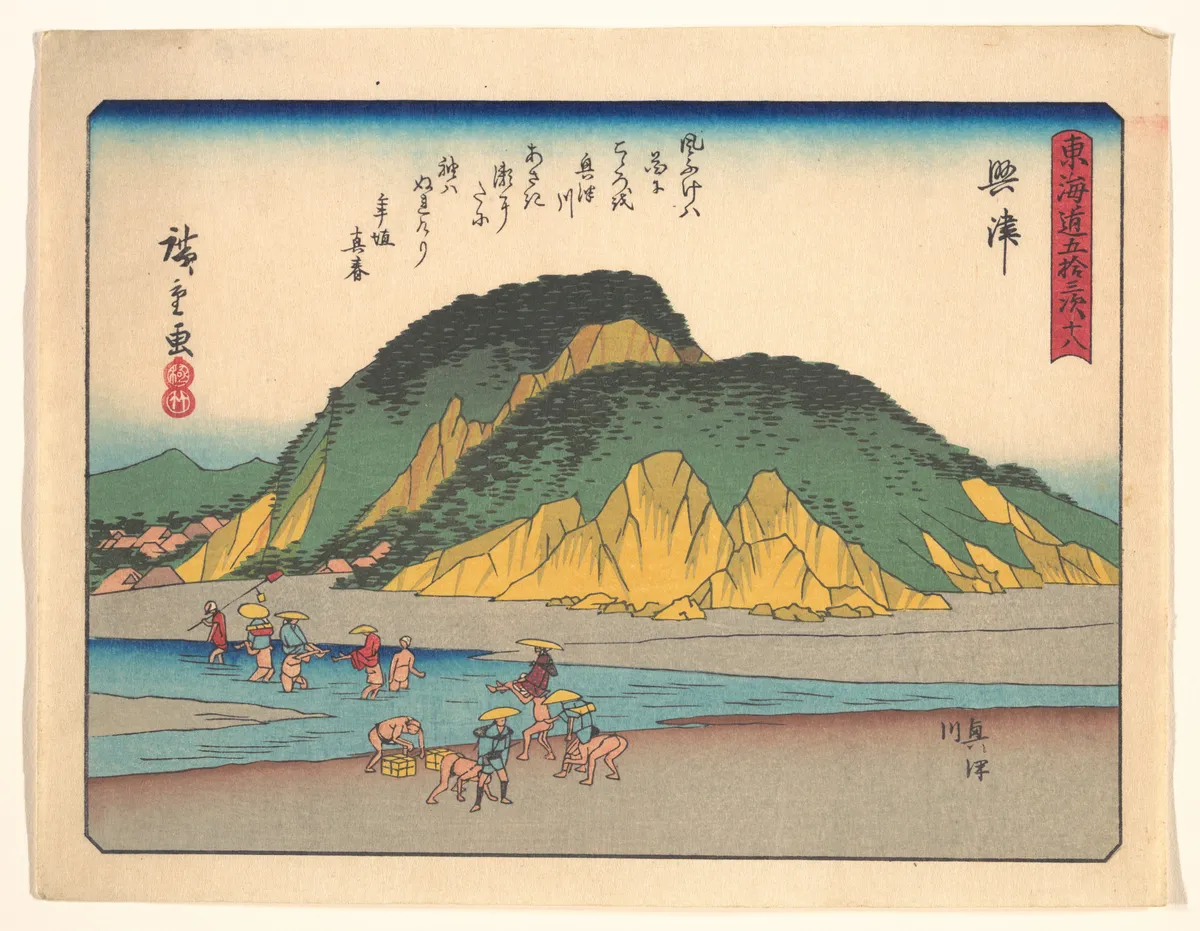
Okitsu Station
The river whispers in the early light. Mist clings to the water's surface, softening the edges of reality. A boatman, strong and silent, steers his craft through the gentle current. His pole dips and rises, a rhythmic dance against the river's flow.
Travellers huddle together, wrapped in layers against the morning chill. Their breaths form little clouds, vanishing quickly in the damp air. Each face is a story untold, eyes fixed on the pale horizon where the mountains loom like distant dreams.
The riverbank is a line of muted greens and browns, trees heavy with the weight of wet foliage. The air is thick with anticipation, the journey stretching ahead like the river itself. Silence hangs over the scene, broken only by the soft lapping of water against wood.
Okitsu, a station on the famed Tōkaidō road. A place of passage, of transient footsteps and fleeting moments. In this quietude, time seems to pause, the world reduced to the essentials of earth, water, and sky.
Historical Echo
The Tōkaidō was the lifeline between Edo and Kyoto. A road of commerce, culture, and connection. Hiroshige captured its essence, its countless stations, each a microcosm of Edo life. Okitsu, one of fifty-three, stands eternal in this print, a gateway to Japan's past.
Hiroshige's work reflects the shinhanga movement's embrace of traditional subjects with modern techniques. Even in the early 20th century, the echoes of Edo resonated, immortalised in wood and ink. The journey continues, the river flows, and the art remains—a bridge across time.