

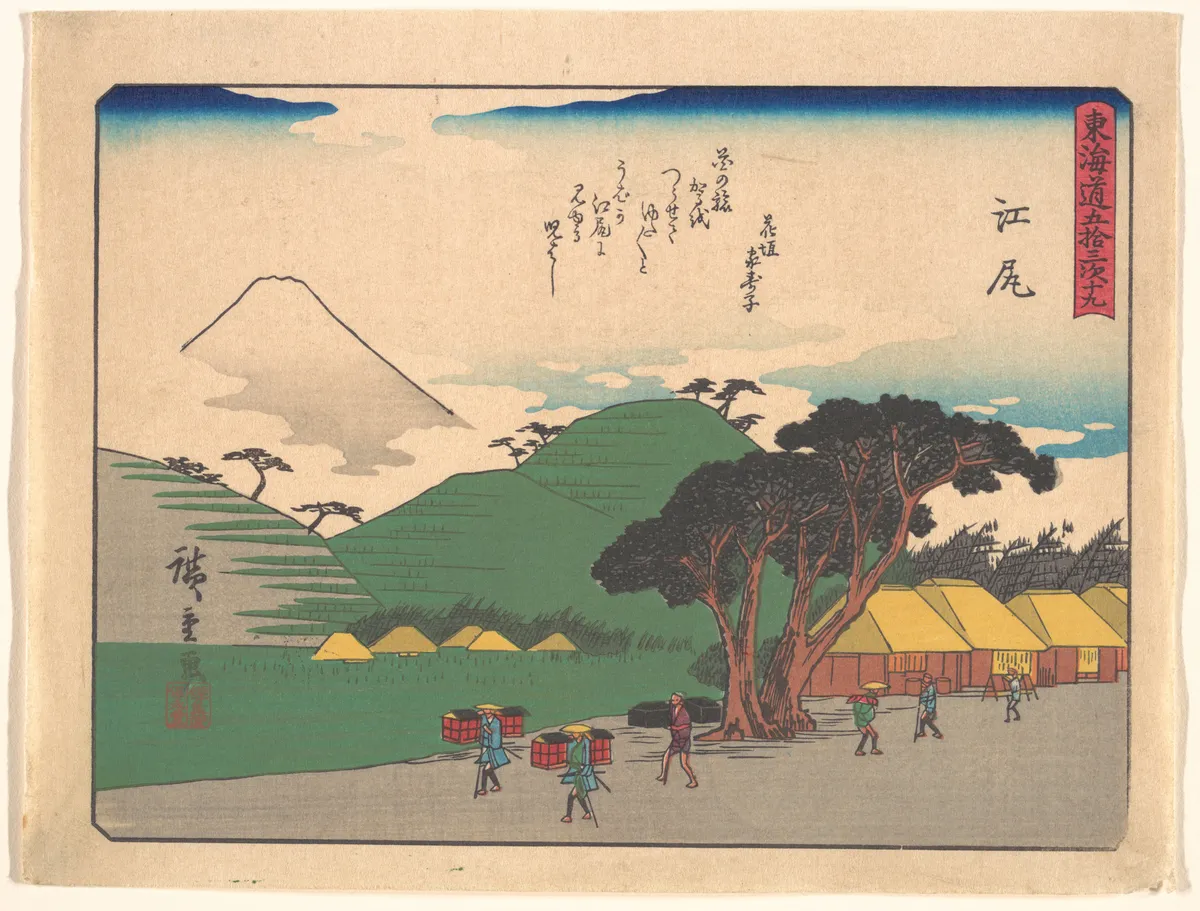
Ejiri on the Tokaido
A gentle mist clings to the air. The road stretches ahead, worn by countless footsteps. Pine trees, their needles whispering, line the path. The Tokaido road, ancient and silent, leads through Ejiri. Travellers move slowly, their sandals padding softly on the damp earth. A lone figure pauses, adjusting their straw hat, eyes scanning the horizon.
The sky, a muted grey, promises rain. In the distance, Mount Fuji looms, its peak shrouded in cloud. It watches, eternal and unmoving. The landscape breathes with a quiet rhythm, the air thick with the scent of pine and earth. A cart creaks as it passes, wheels crunching over gravel.
Nearby, a small teahouse beckons, smoke curling from its chimney. Inside, the warmth of the hearth offers solace. Tea is poured, steam rising gently. The sound of quiet conversation hums like a gentle stream. Outside, the world remains hushed, as if holding its breath.
Evening approaches, shadows lengthening. The road awaits, endless and patient. Each traveller carries their own stories, woven into the fabric of the Tokaido. The journey continues, a timeless passage through history.
Historical Echo
The Tokaido road was the main travel artery of the Edo period, connecting Edo to Kyoto. Hiroshige's prints capture this journey in a series of fifty-three stations, each with its own unique character. Ejiri, nestled between sea and mountain, was a place of rest and reflection. In Hiroshige's work, the ordinary becomes extraordinary, the mundane suffused with quiet beauty. His art evokes a world on the cusp of change, where tradition and modernity meet.