

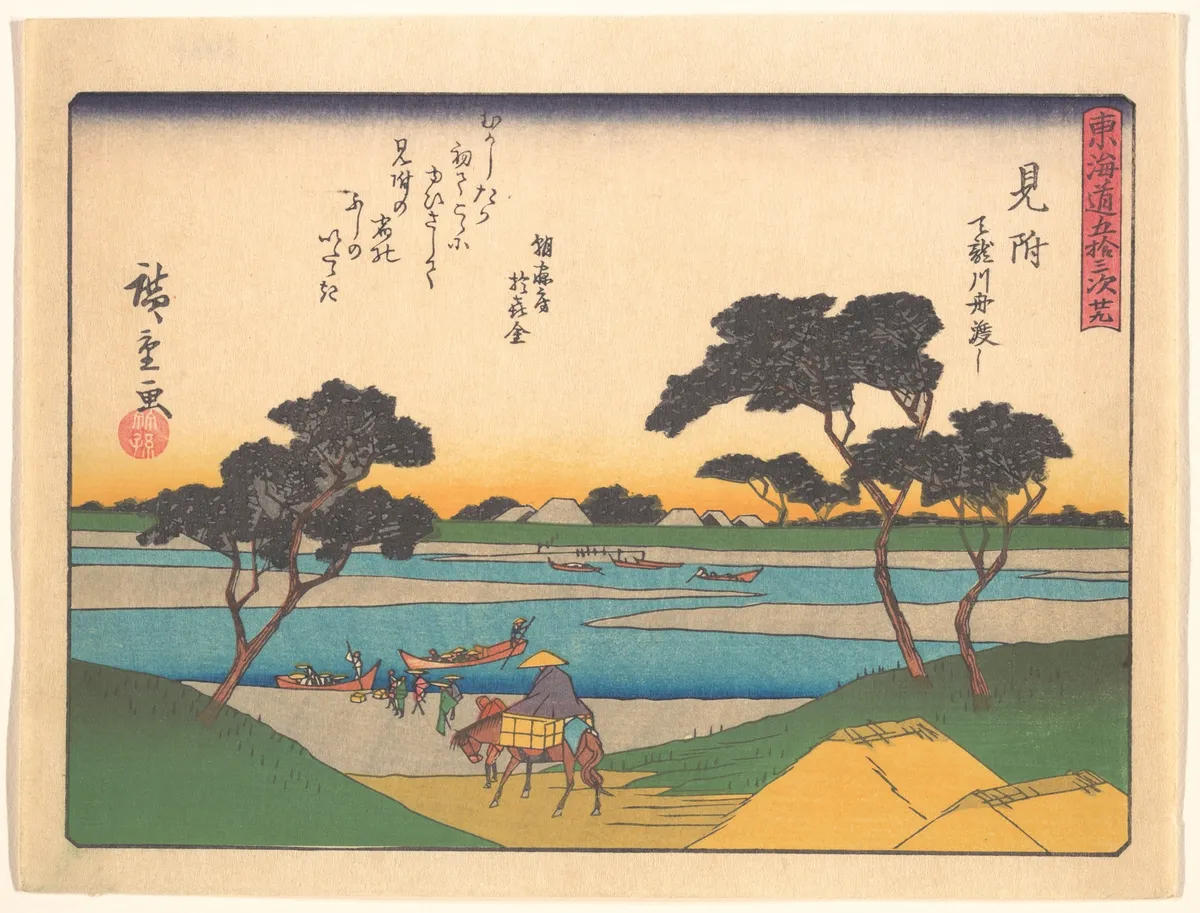
Crossing the Tenryu River
Mist clings to the river's edge like a ghostly veil. The Tenryu River flows silently, its surface smooth like polished jade. A wooden boat creaks under the weight of passengers, their breaths visible in the cold air. The ferryman, silent and steady, poles the boat through the gentle current.
Travellers huddle under straw hats and thick cloaks, their faces obscured by shadows. They are weary from the road, eyes fixed on the opposite bank. The river is wide, a barrier between the known and the unknown.
Above, the sky hangs heavy with clouds, promising rain. The air smells of damp earth and distant pine. No one speaks. Only the soft lapping of water against wood breaks the silence.
A lone crane stands motionless at the water's edge, its reflection a ghostly twin in the grey water. A world paused, caught between journeys.
The ferryman's pole sinks into the riverbed, propelling them forward. Slowly, the opposite bank draws near, a promise of rest and warmth.
In the distance, a temple bell tolls, a deep sound carried by the wind. As the boat reaches the shore, the spell breaks. Feet shuffle, a child laughs, and the world begins again.