

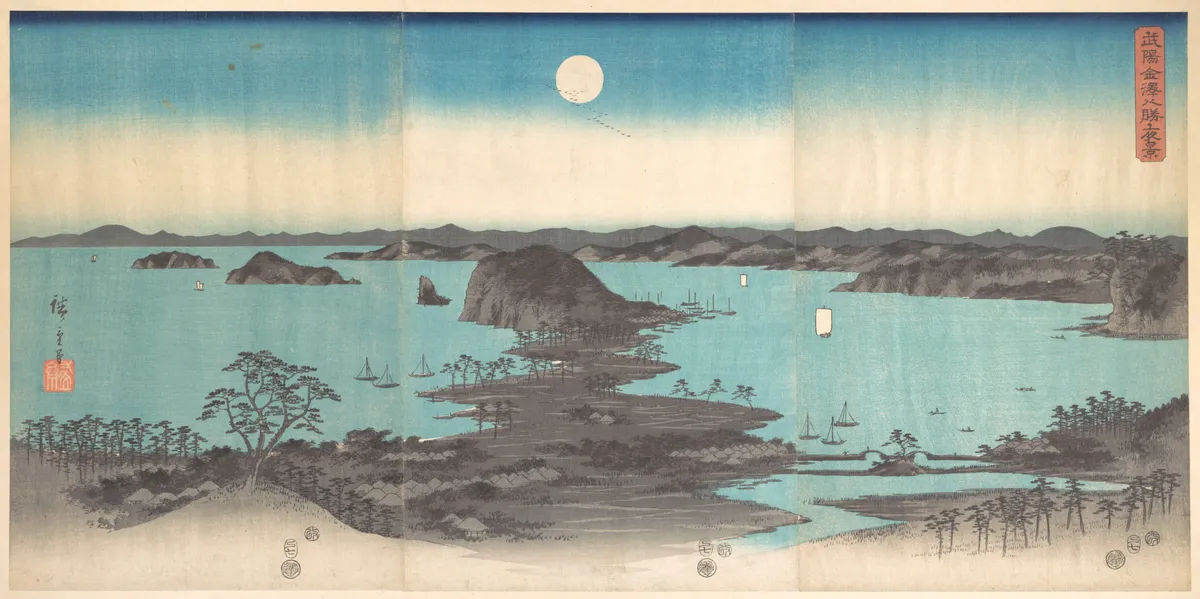
Under the Full Moon
A quiet night unfolds. The full moon bathes Kanasawa in a muted glow. Shadows stretch over the landscape, soft and elongated. Trees stand quietly, their leaves whispering in the gentle breeze. The air is cool, carrying the scent of pine and damp earth. Across the horizon, the silhouette of distant mountains looms, their peaks touched by silvery light.
A solitary figure wanders along a narrow path. His footsteps are soft on the earth, barely disturbing the night's quietude. He pauses, eyes drawn to the reflection of the moon on a still pond. The water mirrors the sky, a perfect circle of light amidst the darkness.
Nearby, a small village nestles among the hills. Lanterns flicker in the windows, casting warm, inviting glows. The faint sounds of laughter and conversation drift through the air, mingling with the chirping of crickets.
The figure continues on, crossing a wooden bridge that creaks gently underfoot. Below, the river flows silently, its surface shimmering with moonlight. He stops midway, leaning on the railing, his gaze lost in the endless night.
The scene is timeless, captured in Hiroshige's gentle strokes. Each element—a tree, a house, a figure—holds its place in the composition, balanced and harmonious. The full moon watches over all, an eternal witness to the quiet beauty of Kanasawa.
Historical Echo
Utagawa Hiroshige, a master of ukiyo-e, created this serene panorama in 1857. It is part of his celebrated series depicting the Eight Views of Kanasawa. Hiroshige's work captures the tranquil beauty of rural Japan, with a focus on nature's subtle interplay with light and shadow. The full moon, a recurring motif in his art, symbolises calm and contemplation. In this piece, the moonlight unifies the scene, inviting viewers into a moment of stillness and reflection.